How to Create Maze Activity Books for Amazon KDP
How to create maze activity books for Amazon KDP: audience, difficulty, interiors, solutions, and a free maze generator.
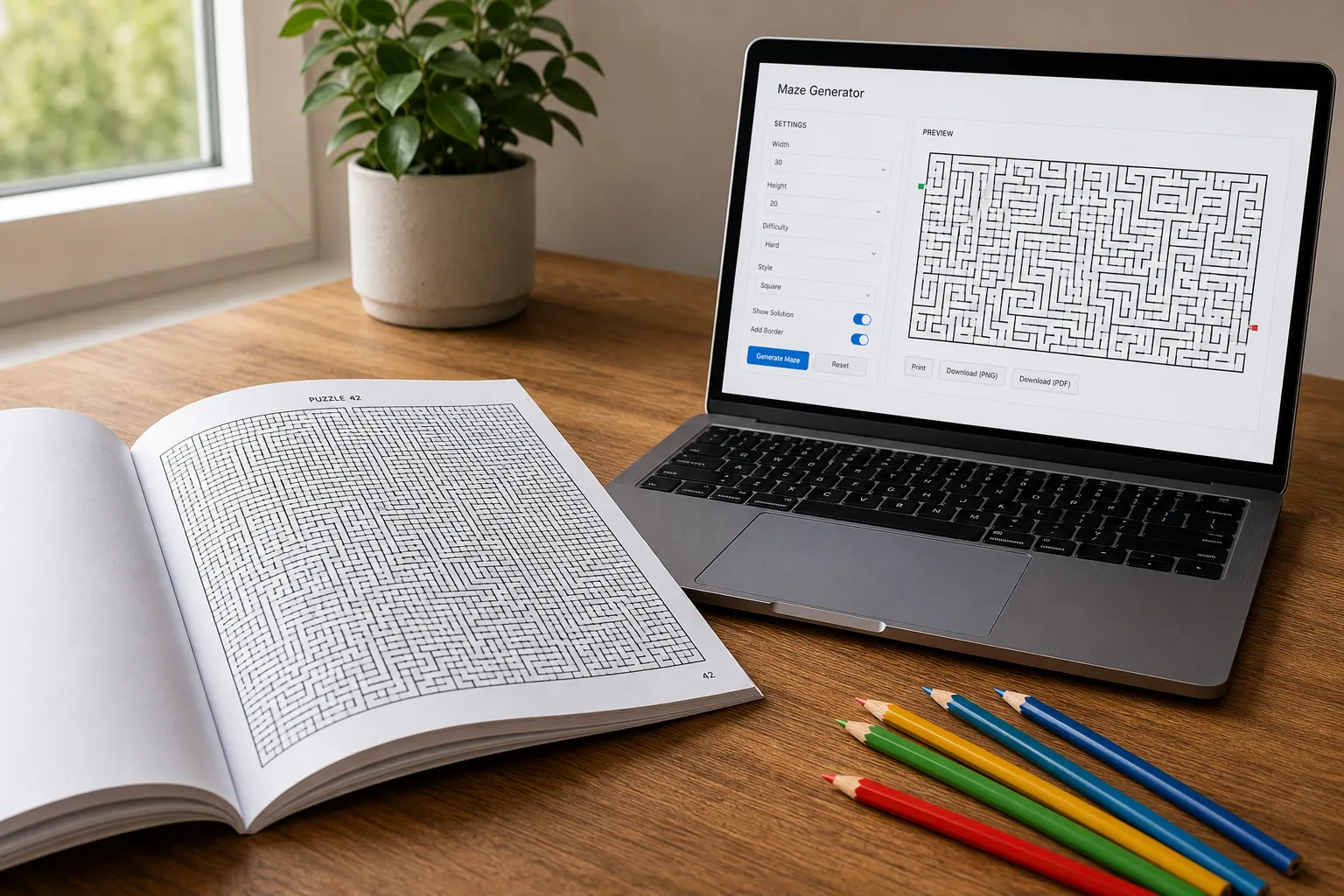
How to create maze activity books for Amazon KDP starts with audience and difficulty, then a print-ready interior with matching solutions. Generate validated mazes in the KDP maze generator, and keep this how-to complementary to the tool landing page.
Maze books are one of the most visually engaging low-content products on Amazon KDP. They sell across a wide audience range, kids, adults, seniors, and gift buyers, and they differentiate primarily through difficulty, visual complexity, and niche theming. Unlike word puzzles, mazes have an immediate visual appeal in "Look Inside" previews that can tip buying decisions on the search page.
The challenge for publishers is that creating mazes manually is genuinely difficult. A well-formed maze needs a single correct path, deliberate dead ends, and consistent visual complexity. Do that by hand for 100 mazes and you'll spend weeks. Do it with a dedicated generator and you spend an afternoon.
This guide walks through the full process: niche selection, maze generation, interior assembly, cover design, KDP listing, and series strategy.
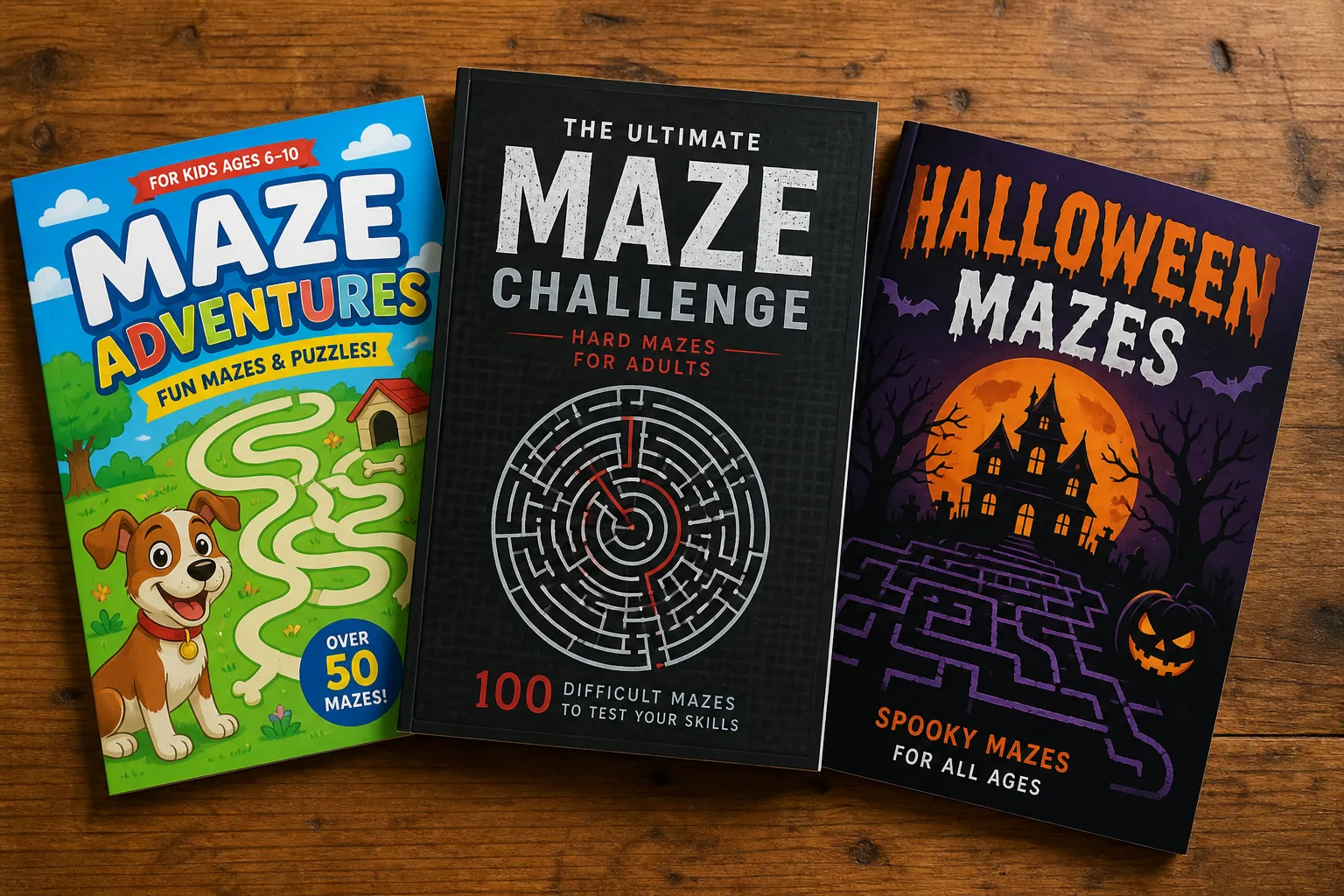
See also: dot-to-dot activity books, full-page maze trim sizes, and maze solution page standards.
Why Maze Books Are a Strong KDP Opportunity
Visual "Look Inside" advantage. A maze page is immediately engaging. When Amazon shoppers click "Look Inside," a full-page maze communicates quality and complexity better than any text puzzle. This lowers the conversion barrier.
Wide audience reach with one production system. Simple mazes target kids; complex multi-path mazes target adults; large-print simple mazes target seniors. One generator with configurable complexity serves all three without separate design workflows.
Thematic differentiation is easy. Maze shapes, border styles, and background illustrations can be adapted to themes. Halloween, Christmas, animals, travel, giving you calendar-ready variants of your base product.
Strong gifting signal. Activity books register as thoughtful gifts. "Maze book for kids" and "maze book for adults" both appear in gift-search behavior. This drives Q4 sales spikes that crossword and sudoku books don't always match.
Step 1: Choose Your Maze Book Niche
High-opportunity sub-niches:
- Easy Mazes for Kids (Ages 4-8): strong parent and teacher purchase intent; safe content; bright covers
- Hard Mazes for Adults: underserved by quality publishers; engaged buyers who write detailed reviews
- Large Print Mazes for Seniors: accessibility-focused; same seniors niche as large-print word searches and sudoku
- Themed Maze Books: Halloween, Christmas, animals, geography; seasonal sales cycles
- Maze + Activity Combo Books: mazes paired with dot-to-dots, coloring pages, or word searches; higher perceived value, better gift positioning
- Escape Maze / Adventure Maze: narrative-driven maze books where each maze leads to a story choice; premium positioning
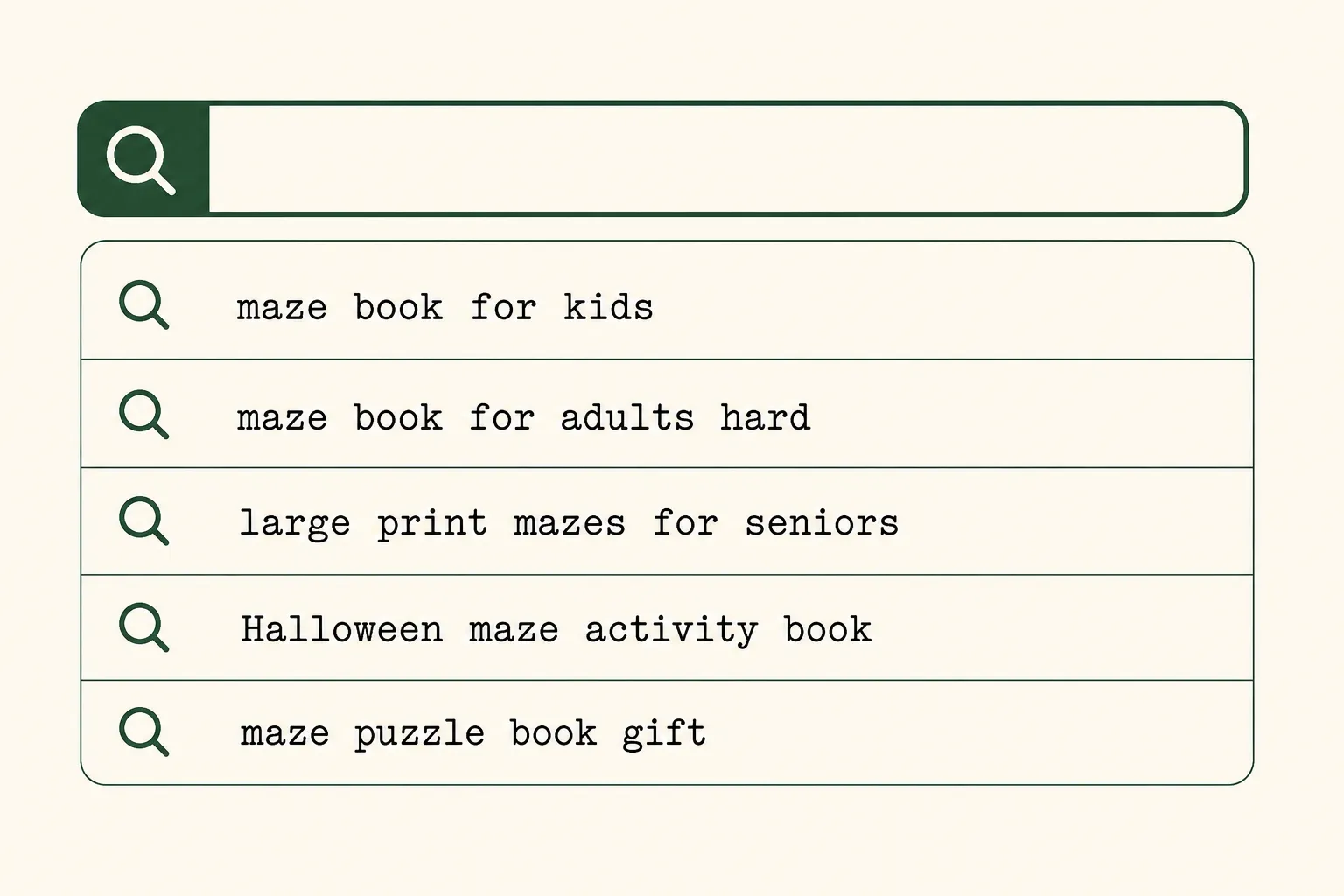
Research approach: Search Amazon for "maze book" and filter to Books. Record the BSR and review count for the top 20 results. Look for sub-categories where the top listing has under 300 reviews, this signals an achievable entry point. Check Google Trends for seasonal peaks in your planned theme.
Step 2: Generate Your Mazes
What Makes a Valid Maze for Print
A print-quality maze must have:
- Exactly one correct path from start to finish
- Deliberate dead ends that create genuine challenge (not just a straight line with decorations)
- Consistent visual complexity appropriate to the stated difficulty level
- Clean, scalable output: grid lines and walls must print sharply at full page size
- Solution page for every maze
Manual construction fails on all five criteria at book scale. A dedicated maze generator handles all of them automatically.
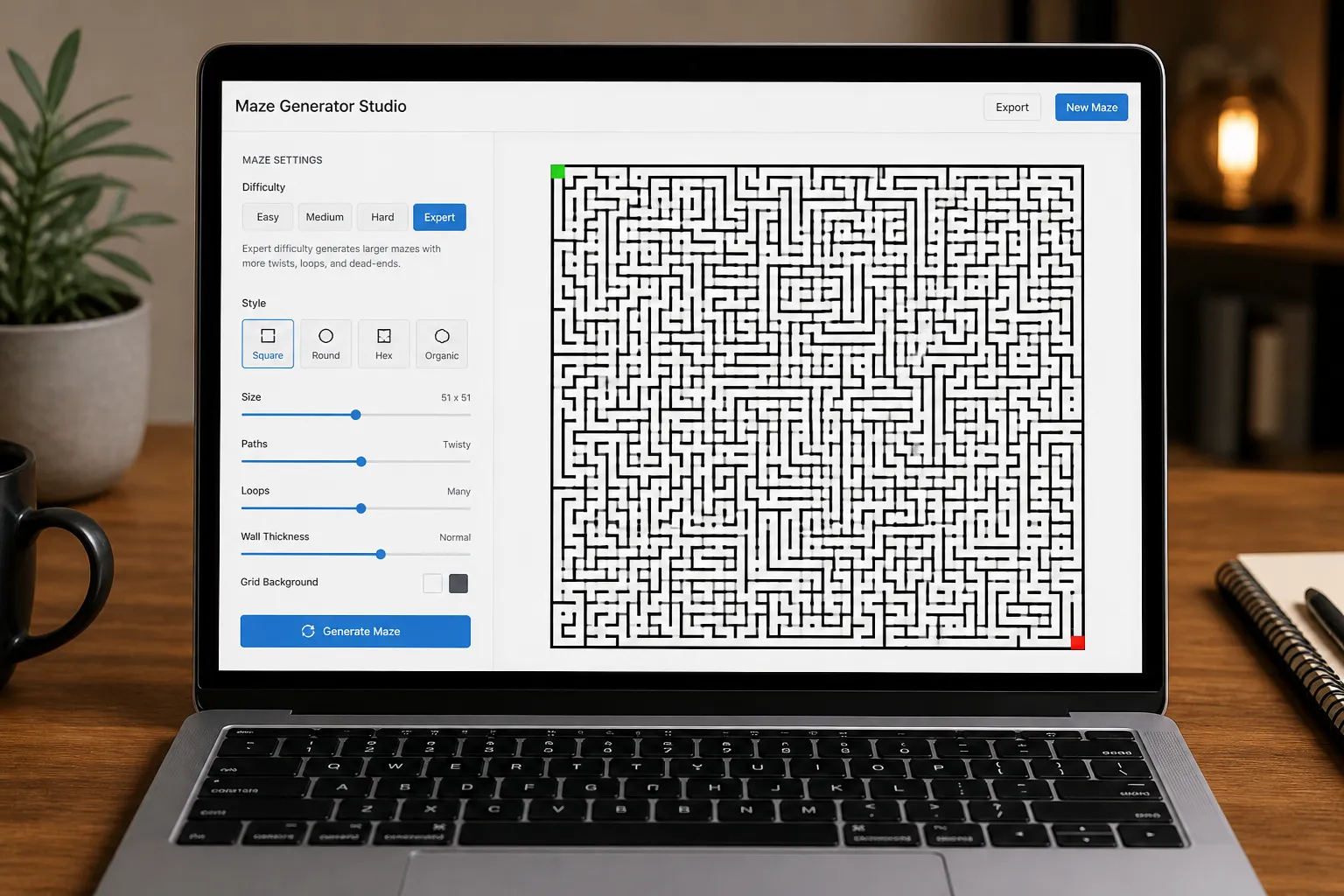
RodBooks Maze Generator generates mazes with:
- Configurable difficulty: from simple single-path easy mazes to complex multi-branch expert layouts
- Multiple maze styles: rectangular grid mazes, circular mazes, hexagonal grid mazes
- Scalable output: vector-based pages that stay sharp at KDP's print resolution
- Automatic solution pages: every maze comes with its solution ready to include in the answer key
- Book assembly: set maze count, add front matter, configure solutions, and export one PDF
Difficulty Settings for Maze Books
Match your stated difficulty to the maze's structural complexity:
| Level | Path Complexity | Dead Ends | Best Audience |
|---|---|---|---|
| Easy | Short paths, few branches | Shallow, obvious | Young kids (4-6), seniors |
| Medium | Multiple branches, some long dead ends | Moderate | Kids 8+, casual adults |
| Hard | Long winding paths, many dead ends, loops | Deep, misleading | Adult puzzle solvers |
| Expert | Maximum branching, backtrack-heavy | Extensive | Serious maze enthusiasts |
Step 3: Structure Your Maze Book Interior
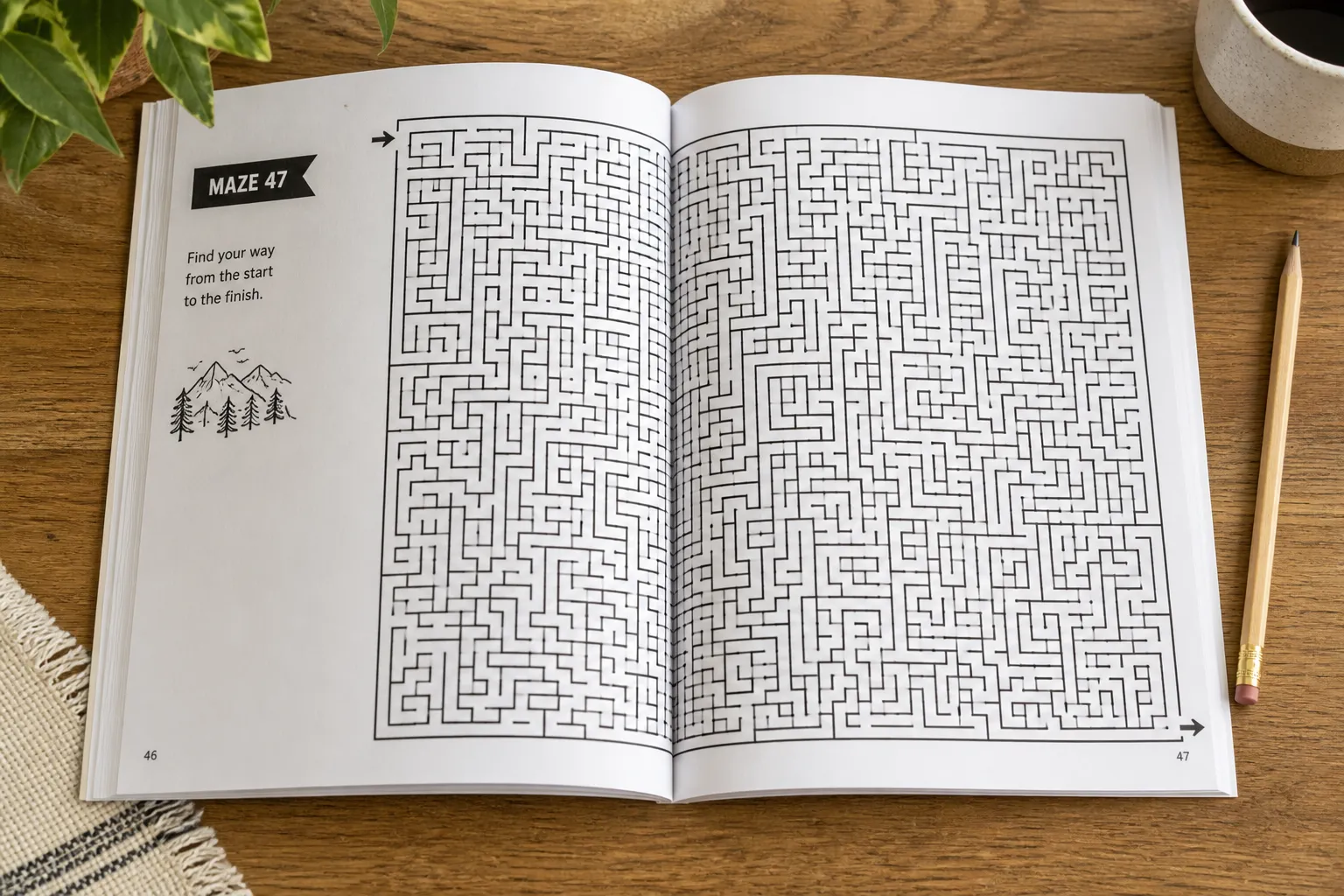
A maze book is more visual than a sudoku or crossword book, so the interior pacing matters more. Buyers open the "Look Inside" and scan 3-4 pages, those pages need to show clean, well-proportioned mazes.
Standard interior structure:
| Section | Notes |
|---|---|
| Title page | Title, subtitle, audience, volume number |
| Copyright page | Year, publisher, rights notice |
| How to Use (optional but recommended for kids) | Brief instructions and example |
| Maze run | All mazes in order, one per page (or 2 for easy/kids) |
| Solutions section | Compact solved mazes, 4 per page for large, 6 for small |
Maze layout options:
- One maze per page: standard for adult, hard, and large mazes
- Two mazes per page: acceptable for easy/kids editions where mazes are smaller
- Full-bleed maze: maze extends to the page edges; requires bleed in the PDF; creates premium feel
Page count guidance:
- 6×9 in, 1 maze/page: 80-100 mazes produces 160-200 interior pages (add front matter + solutions)
- 8.5×11 in, 1 maze/page: 100-150 mazes works well for adult books
- Kids books (8.5×11): 50-80 mazes with larger, simpler layouts is standard
Step 4: Design Your Maze Book Cover
Maze book covers have different visual conventions from sudoku or crossword covers.
Cover design principles:
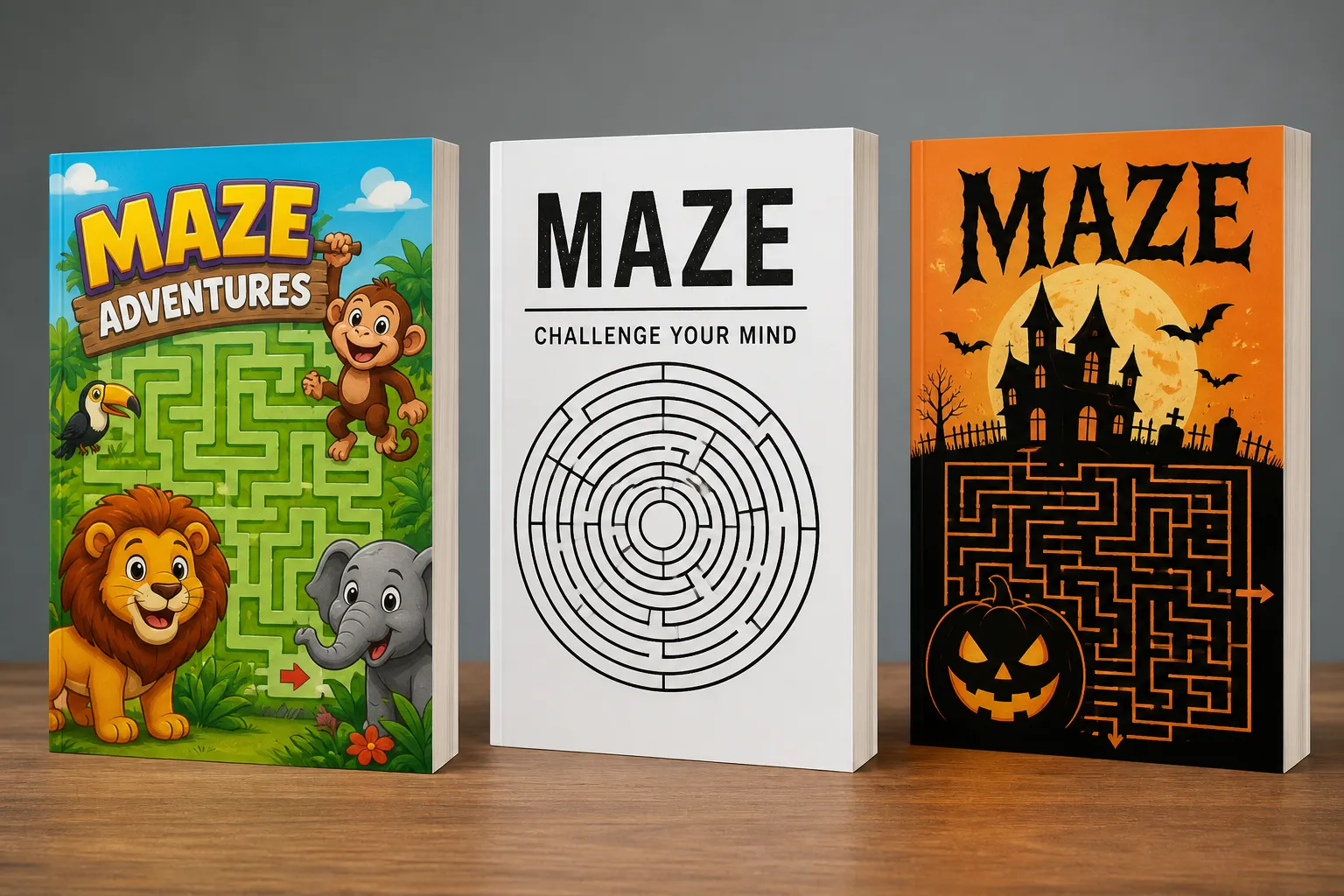
- Show a maze. The cover should include a maze visual, whether a fragment of a complex maze, a maze path, or an abstract maze-pattern background. Maze buyers respond to visual "puzzleness" on the cover.
- Kids books need color and character. For children's editions, illustrated characters navigating a maze, bright colors, and a friendly typeface communicate the audience immediately.
- Adult books should be bold and minimal. High contrast (black maze pattern on white or dark background), strong typography, difficulty label.
- Themed books need thematic imagery. A Halloween maze book needs orange, black, and appropriate iconography. Christmas maze books need the seasonal visual language. Generic covers underperform themed ones in seasonal searches.
- Always label difficulty and audience prominently.
Step 5: Upload to KDP and Format Your Listing
Interior upload checklist:
- PDF is clean (no hidden layers, embedded fonts)
- Maze walls are sharp lines (vector, not rasterized)
- Solution mazes are legible at compact size
- Bleed included if using full-bleed layout (0.125 in on all sides)
- Page size matches your selected trim
KDP Previewer checks for maze books:
- Maze walls print clearly, no aliasing or blur
- No maze content is cut off near margins
- Solution pages show correct paths (spot-check 3-5 random solutions against their puzzles)
- Page numbers are consistent
Title Formula
[Adjective] Maze [Type] [for Audience], Vol. [N]: [Puzzle Count] [Feature]
Examples:
- *Hard Maze Book for Adults, Vol. 1: 100 Challenging Puzzles with Solutions*
- *Easy Mazes for Kids Ages 4-8. Fun Activity Book with 80 Big Mazes*
- *Halloween Maze Activity Book: 60 Spooky Mazes for Kids and Adults*
Backend Keywords
maze book for adults hard challengingmaze activity book kids childrenmaze puzzles large print seniorshalloween maze book activitymaze puzzle book gift adultsactivity book mazes brain gameskids maze workbook school fun
Categories
- Books > Children's Books > Activities, Crafts & Games > Activity Books (for kids editions)
or Books > Humor & Entertainment > Word Games > Mazes (for adult editions)
- Books > Crafts, Hobbies & Home > Crafts & Hobbies > Puzzles
Step 6: Pricing, Launch, and Seasonal Strategy
Pricing benchmarks:
- 6×9 in, 80-100 mazes (adult): $7.99-$9.99
- 8.5×11 in, kids activity: $6.99-$9.99
- Themed seasonal: $9.99-$12.99 (scarcity and gift positioning support a premium)
- Jumbo / combo activity books: $12.99-$16.99
Seasonal strategy for maze books: Maze books respond to seasonal keywords more than most puzzle genres. Plan your publication calendar around:
- Q3 (September): Halloween-themed mazes (publish by early September for Q4 indexing)
- Q4 (October-November): Christmas maze books, winter activity books
- Q1 (January-February): New year activity books, Valentine's Day themes
- Q2 (April-May): Spring themes, Easter activity books
Build evergreen volumes (Easy Mazes for Adults Vol. 1) and themed seasonal volumes (Halloween Maze Book). The seasonal titles spike and the evergreens provide baseline royalties year-round.
Common Mistakes in Maze Book Publishing
Mazes with no solution or multiple paths. Always verify every maze has exactly one valid solution before export. Test 5-10 random mazes manually before publishing.
Covering too many difficulty levels in one book. A single volume mixing Easy, Medium, Hard, and Expert mazes confuses buyers and weakens keyword targeting. One difficulty per volume, clearly labeled.
Generic covers on themed books. A Christmas maze book with a generic cover loses to a festive, themed cover in every A/B comparison. Invest in theme-appropriate cover design.
Not publishing a kids edition. If your maze generator supports simple mazes, the kids/family edition is often your highest-volume seller. Teachers and parents are systematic buyers.
Skipping A+ Content. A+ Content on maze books lets you show interior pages directly on the product listing. A visual of a complex maze inside the A+ module significantly increases conversion for adult editions.
Using RodBooks for Maze Book Production
RodBooks Maze Generator handles the entire production pipeline:
- Generate mazes at configurable difficulty and style
- Set trim size, maze count, and solution density
- Preview every page layout before export
- Compile front matter, maze run, and solution section into one PDF
- Download a print-ready file for KDP upload
Start with a free account to test the full maze workflow.
Frequently Asked Questions
Do maze books need solutions?
Yes. Every maze book should include a solution section at the back. Buyers who get stuck, especially casual or senior buyers, expect to find the answer. Missing solutions are a reliable source of negative reviews. Include compact solved maze pages grouped 4-6 per page at the back of the book.
What is the best trim size for a kids maze activity book?
8.5×11 in is standard for kids activity books. The larger page allows bigger maze grids that are appropriate for young solvers and also creates a distinctive "activity book" look on the shelf. 6×9 in works for adult maze books where a trade paperback feel is preferred.
Can I sell both a kids and adult maze book from the same puzzle set?
No, the same puzzles would be too hard for young children and too easy for adult solvers. Generate separate puzzle sets for each difficulty level and audience. You can use the same generator workflow but with different difficulty settings and grid sizing.
How do I make mazes harder without just making them bigger?
True difficulty comes from dead-end complexity and branch density, not from maze size. An Expert 9×9 grid can be harder than an Easy 20×20 grid. Use a generator with proper difficulty calibration, not just size adjustment.
Are themed maze books worth the extra design work?
Yes, if published 6-8 weeks before the peak season. A Halloween maze book published on September 1 has enough time to index, gather initial reviews, and rank for seasonal searches in October. The extra cover design investment is offset by the seasonal sales spike.
Pre-Publish Checklist
- Niche and audience confirmed with BSR research
- Difficulty level defined and consistently applied to all mazes
- All mazes validated, one solution each, no dead-end loops
- Interior previewed: maze size, margins, solution pages confirmed
- PDF exports cleanly, opens in KDP Previewer without errors
- Cover designed with correct difficulty/audience labeling
- Title follows audience + difficulty + volume formula
- Backend keywords cover gift, activity, and audience variants
- 2 KDP categories selected
- A+ Content module with interior maze images prepared
- Seasonal publish date planned (if themed)
- Next volume production started