Best KDP Trim Sizes for Puzzle and Activity Books
Which KDP trim size fits crossword, sudoku, maze, and word search books: 5x8, 6x9, 7x10, and 8.5x11 with royalty impact, generator presets, and links to bleed and spine guides.
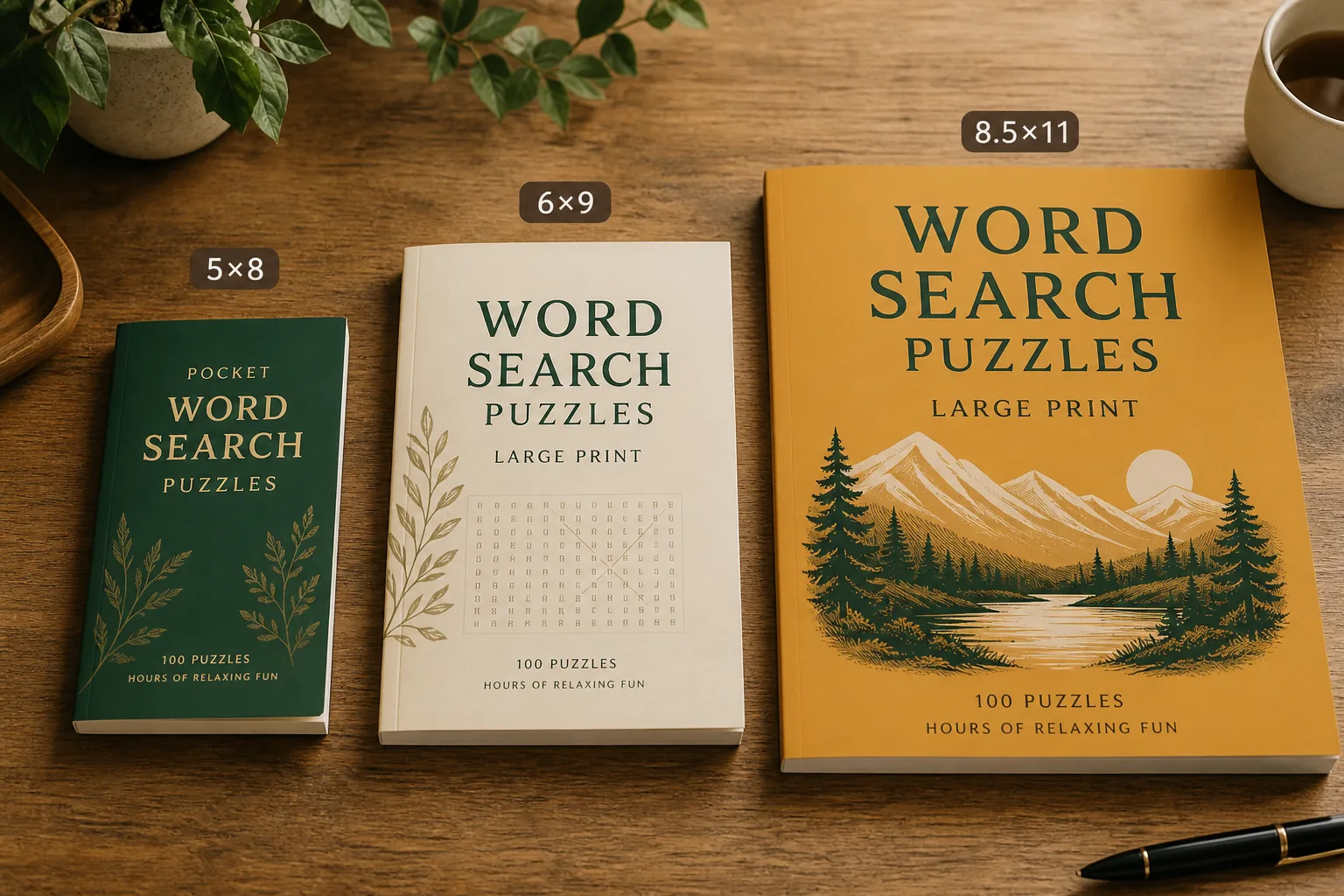
Choosing the best KDP trim sizes for puzzle books affects readability, print cost, price anchoring, and royalties. Cross-check bleed vs no bleed for KDP and spine width and full-wrap covers before you export interiors. Model list price in the KDP royalty calculator. This guide covers 5x8, 6x9, 7x10, 8x10, and 8.5x11 with specs for crossword, sudoku, word search, and maze books.
Trim size is one of the most consequential decisions you make before publishing a KDP puzzle book. It determines your page count, your royalty per sale, your production cost, your buyer perception, and the minimum margin requirements your interior PDF must meet. Getting it wrong means a KDP reject on upload, a price that doesn't cover your costs, or a book that feels cheap compared to competing titles in your niche.
This guide covers every KDP-supported trim size relevant to puzzle and activity book publishing, what each is best for, exact margin and bleed requirements, how to calculate spine width, and how to configure your interior generator to output the right dimensions.
See also: how many puzzles per KDP book, solution page layout standards, and large-print word search for seniors.
Why Trim Size Matters More for Puzzle Books Than Other Low-Content Books
For a journal or lined notebook, trim size is mostly a matter of buyer preference. For puzzle books, it directly affects:
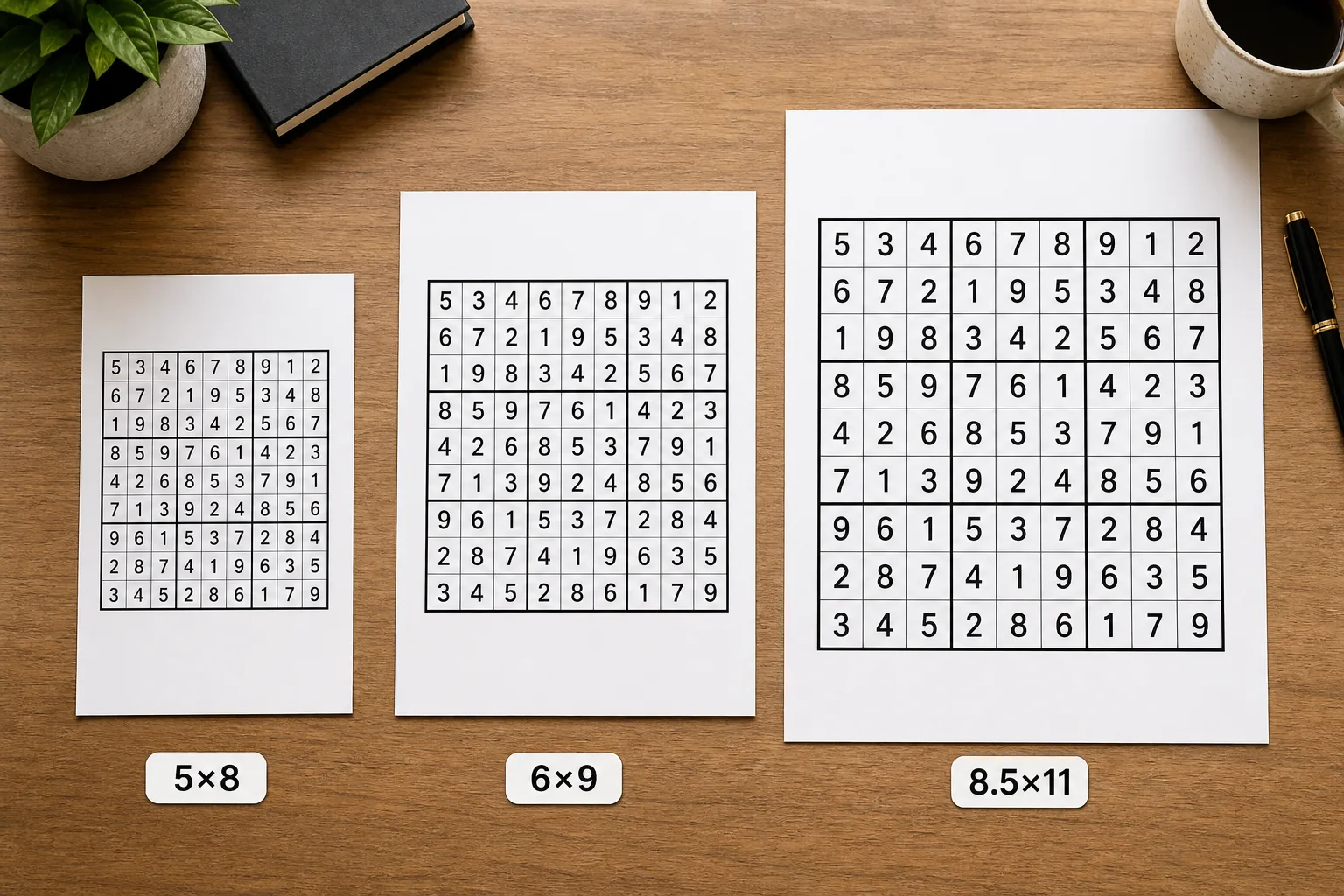
Grid readability. A 9x9 sudoku grid on a 5x8 page has smaller cells than on an 8.5x11 page. For seniors or buyers with visual impairment, this is not a cosmetic issue, it determines whether the book is usable.
Clue column width. Crossword books need enough horizontal space for two or three clue columns. On a 6x9 page, a 15x15 grid already occupies most of the usable width. On 8.5x11, you have room for a cleaner two-column clue layout beside the grid.
Puzzle count and page math. Larger trim sizes allow larger individual puzzle elements, which means fewer puzzles per page (usually one) but a better solving experience. The relationship between puzzle size, puzzle count, and page count is tight, and it affects your KDP royalty calculation.
Price anchoring. An 8.5x11 book looks substantially larger on screen and on shelf than a 6x9. Buyers anchor price expectations to perceived size. Large-format puzzle books commonly sell at $2-$4 higher than the same content in 6x9, while still yielding similar royalties because print cost is proportionally lower per page.
The KDP Trim Sizes That Matter for Puzzle Books
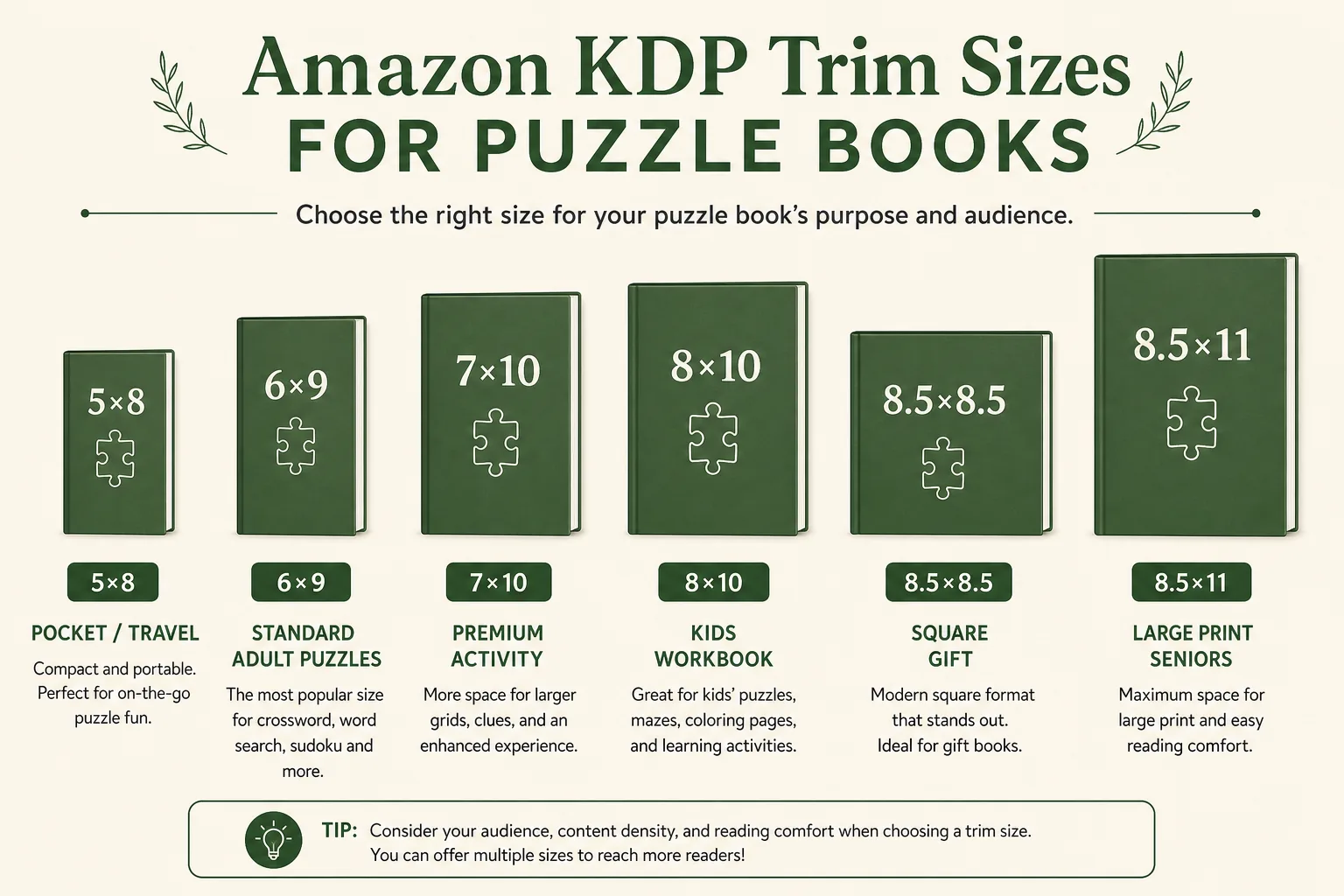
KDP supports dozens of trim sizes. For puzzle and activity books, five sizes account for the vast majority of successful titles.
6 x 9 Inches: The Standard Trade Paperback
Best for: Adult crossword, sudoku, word search, and logic puzzle books; general puzzle series
Print cost: Low-to-medium; royalty-efficient at 100-200 pages
Grid/puzzle fit: 15x15 crossword with two-column clues fits cleanly; 9x9 sudoku at standard font size is comfortable
The 6x9 is the workhorse of KDP puzzle publishing. It matches the dimensions of trade paperbacks from mainstream publishers (Dell, Simon & Schuster puzzle lines). Buyers perceive it as a "proper" book, not a workbook or activity pad. It fits in a bag or purse, which matters for the travel-use case.
Minimum margins (KDP requirement):
- Outside margins: 0.25 in
- Gutter (inside): 0.375 in for up to 150 pages; 0.5 in for 151-300 pages; 0.625 in for 300+ pages
- Top/bottom: 0.25 in minimum
Typical page count for puzzle books: 150-250 pages (front matter + 100-150 puzzles + solutions)
8.5 x 11 Inches: The Large-Format Workhorse
Best for: Large-print senior editions, mega/jumbo volumes, kids activity books, maze books, combo activity books
Print cost: Higher than 6x9 (larger pages cost more to print)
Grid/puzzle fit: 15x15 crossword with three-column clue layout; 9x9 sudoku in large-print size; full-page mazes
The 8.5x11 is the premium format for puzzle books targeting seniors and for volume positioning ("500 Puzzles"). It justifies a $12-$16 price point that 6x9 books often cannot hold. For kids activity books, it matches classroom and workbook conventions.
Minimum margins (KDP):
- Same structure as 6x9 (0.25 in outside, gutter varies by page count)
- 8.5x11 allows more generous internal spacing without penalty
Typical page count: 200-350 pages for mega volumes; 120-200 for standard editions
7 x 10 Inches: The Overlooked Middle Format
Best for: Activity books, educational puzzle books, premium adult puzzle editions that want more than 6x9 but less bulk than 8.5x11
Print cost: Medium; between 6x9 and 8.5x11
Grid/puzzle fit: Comfortable for crossword and sudoku with slightly larger grids than 6x9
The 7x10 is underused in KDP puzzle publishing, which creates a differentiation opportunity. A 7x10 puzzle book looks distinctly different in Amazon search results from the standard 6x9 stack. It photographs well for covers. It allows slightly larger grids without the full-format commitment of 8.5x11.
8 x 10 Inches: The Activity Book Sweet Spot
Best for: Kids activity books, coloring-puzzle combos, illustrated maze books
Print cost: Medium-high
Grid/puzzle fit: Very generous space for kid-sized mazes and activity pages
The 8x10 sits between the large-format workbook feel and a standard book. It is common in traditionally published children's activity books and gift-oriented puzzle collections.
5 x 8 Inches: The Pocket Format
Best for: Pocket sudoku, travel crossword, commuter word search
Print cost: Low
Grid/puzzle fit: Tight; only small puzzles fit well (6x6 sudoku, 11x11 crossword, simple mazes)
The 5x8 supports a specific use case: compact, portable, impulse-purchase puzzle books. These tend to price at $5.99-$7.99 and compete primarily on price and packaging. The royalty per sale is lower but print cost is also lowest. Useful as a low-entry-point volume in a series.
Trim Size by Puzzle Type. Quick Reference
| Puzzle Type | Recommended Trim | Notes |
|---|---|---|
| Adult crossword (standard) | 6 x 9 in | Best royalty efficiency; trade paperback feel |
| Adult crossword (premium/series) | 8.5 x 11 in | More clue room; large print variant ready |
| Sudoku (standard adult) | 6 x 9 in | One puzzle per page fits cleanly |
| Sudoku (large print / seniors) | 8.5 x 11 in | Required for accessible cell sizing |
| Word search (standard) | 6 x 9 in | Standard; also works well at 8.5x11 |
| Word search (large print) | 8.5 x 11 in | Essential for senior niche |
| Maze (adult, complex) | 8.5 x 11 in | Full-page mazes need space |
| Maze (kids activity) | 8.5 x 11 or 8 x 10 | Activity book convention |
| Combo activity book | 8.5 x 11 in | Variety of puzzle types needs room |
| Pocket / travel | 5 x 8 in | Portable; lower price tier |
| Educational workbook | 7 x 10 or 8.5 x 11 | Matches classroom format |
How Trim Size Affects Your KDP Royalty
KDP's royalty calculation for 60% rate is:
Royalty = List Price x 0.60. Printing Cost
Printing cost depends on page count and trim size (black and white or color interior, white or cream paper). Larger trim sizes have higher per-page print costs.
Example calculations (approximate, B&W, white paper):
| Trim | Pages | Print Cost (approx.) | Min. Price for 60% | Royalty at $9.99 |
|---|---|---|---|---|
| 6 x 9 | 200 | $3.65 | $6.08+ | $2.34 |
| 8.5 x 11 | 200 | $5.45 | $9.08+ | $0.54 |
| 8.5 x 11 | 200 | $5.45 | (at $12.99) | $2.34 |
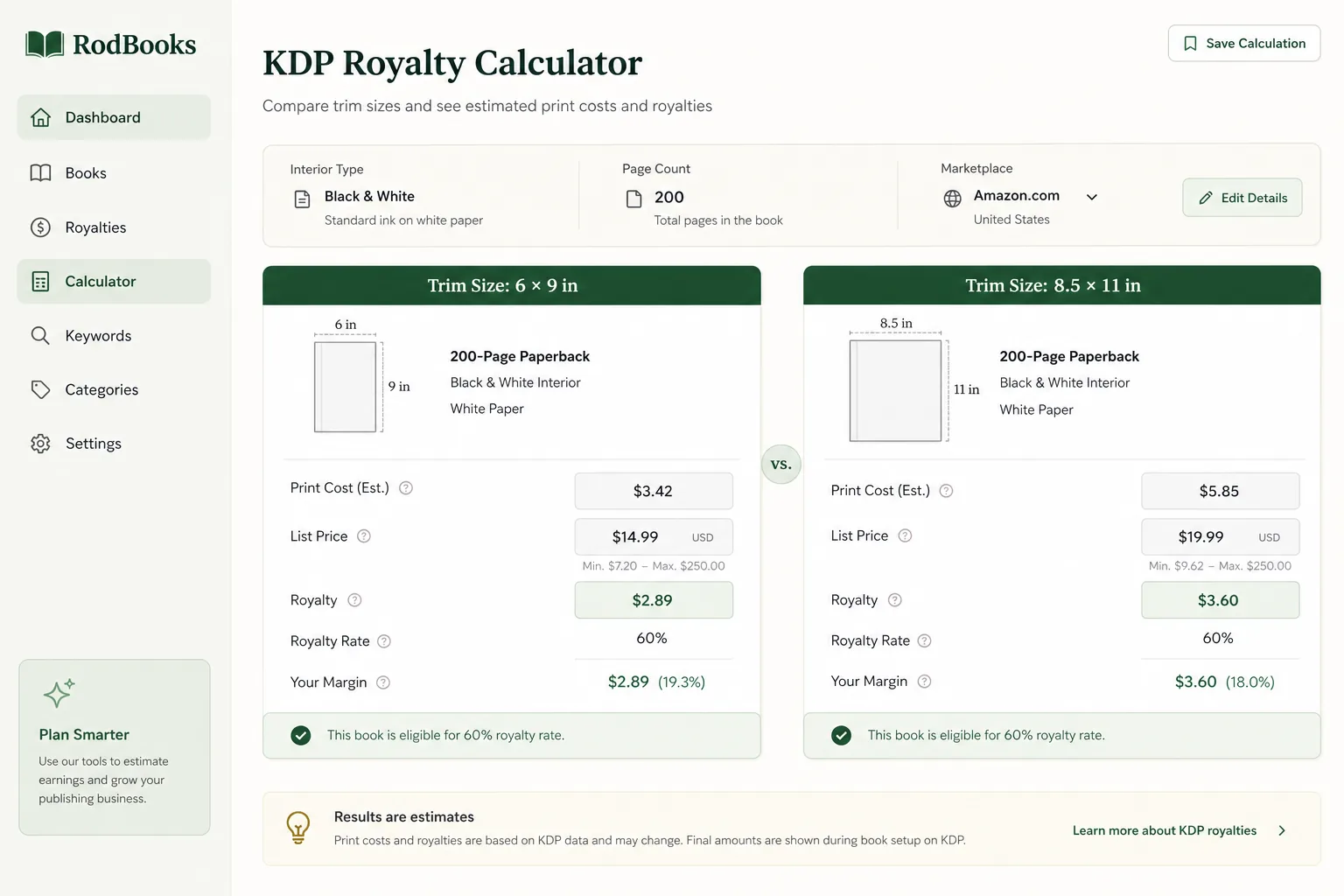
This table shows the critical point: an 8.5x11 book must be priced higher than a 6x9 book to earn the same royalty per sale. This is why 8.5x11 puzzle books typically price at $12.99-$16.99, while 6x9 books price at $7.99-$9.99. Buyers accept this, the larger format justifies a higher price.
Always use KDP's royalty calculator (available on the KDP pricing page) to verify your specific page count and trim before setting a final price.
Spine Width: How to Calculate It
The cover PDF for a paperback must include a spine with width exactly matching your page count. KDP calculates this as:
- White paper: page count x 0.002252 inches
- Cream paper: page count x 0.0025 inches
Example: A 200-page book on white paper has a spine of 200 x 0.002252 = 0.45 in (approximately 0.45 inches wide).
If your spine width is under 0.25 inches (roughly under 110 pages on white paper), KDP will not allow text on the spine. This is important when planning series books, keep page count above 110 to allow spine branding.
Your RodBooks PDF export tells you the page count of the generated book. Use that number in KDP's cover calculator (available on the "Paperback Cover" tab when setting up your title) to get the exact spine width for your cover designer.
Bleed vs. No Bleed for Puzzle Book Interiors
Most puzzle book interiors do not need bleed. Crossword grids, sudoku grids, and word search grids are surrounded by white margin space. Bleed is only needed when a design element (image, colored background, or full-page maze) runs to the very edge of the page.
When to add bleed:
- Full-bleed maze books where the maze extends to the page edge
- Activity books with colored borders or illustrated backgrounds
- Any page where artwork or patterns extend to the trim line
Bleed spec: 0.125 in on each outside edge (top, bottom, and outside edge, not the spine/gutter side for interiors).
If you add bleed to your interior, your PDF page size must be 0.25 in larger than the trim size in both width and height. For a 6x9 bleed interior: PDF pages are 6.25 x 9.25 in.
Configuring Your Generator for the Right Trim Size
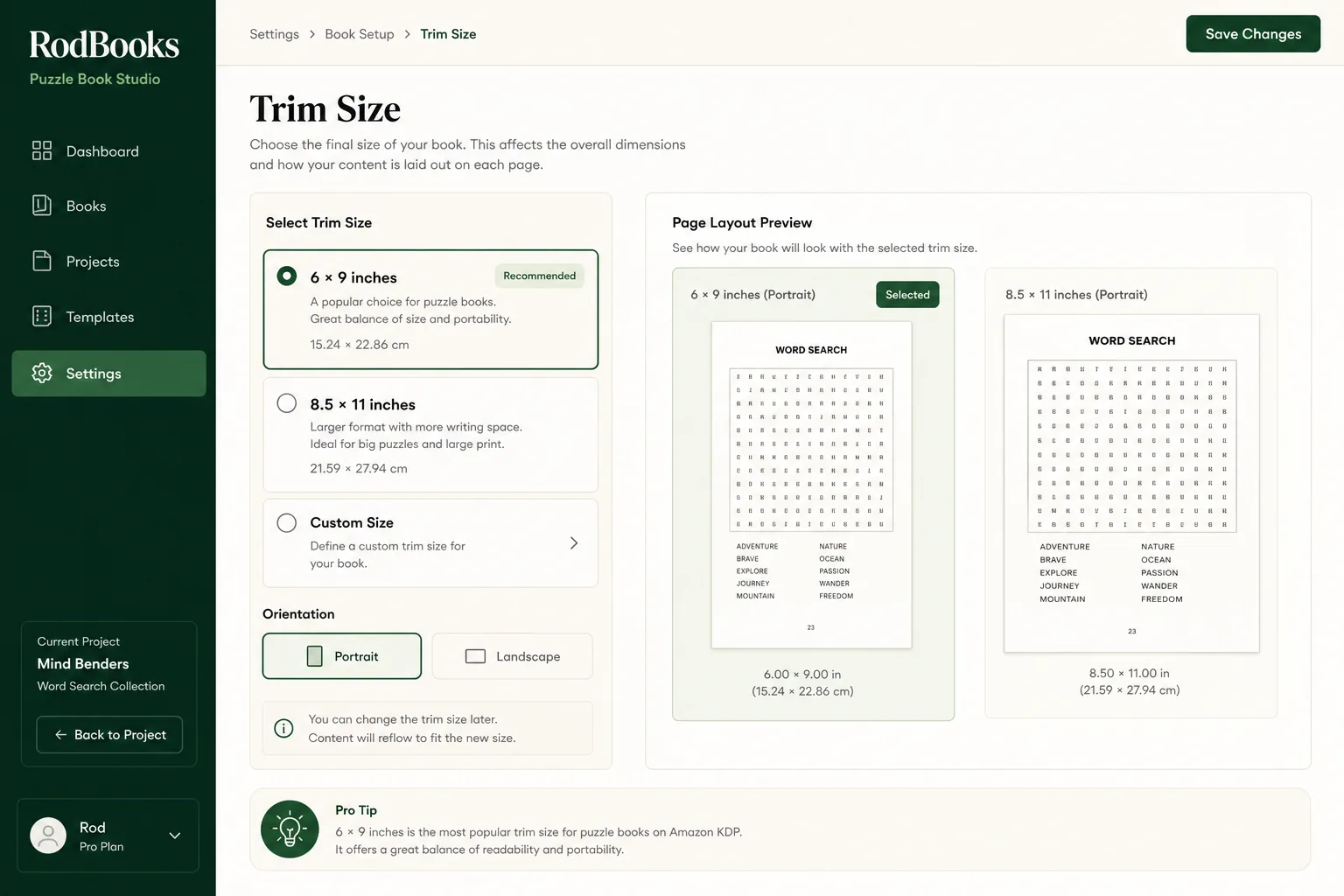
When using RodBooks to generate puzzle books, trim size configuration happens in Step 2 of the workflow (Book settings). Currently supported presets:
- 6 x 9 in: standard trade paperback
- 8.5 x 11 in: large format
Within each preset, you can adjust:
- Grid width and position (for centering on page)
- Clue column layout and font size
- Top/bottom page offset
- Solution grid size and per-page density
The live preview in Step 3 shows the exact page at your chosen trim, so you can verify grid size and margin before export.
Configure your puzzle book trim in RodBooks →
Frequently Asked Questions
Can I change trim size after publishing on KDP?
No. Once a title is published, the trim size is locked. You must unpublish and create a new title if you want a different trim. This is why choosing the right trim before publishing matters, plan your series trim from the start.
Is 6x9 or 8.5x11 better for puzzle books?
It depends on your niche and audience. 6x9 is better for standard adult puzzle books (lower price, trade paperback feel, higher royalty at standard pricing). 8.5x11 is better for seniors (large print), mega volumes (500 puzzles), and kids activity books (matching workbook conventions). Many successful publishers publish both trims for every series.
What trim size do mainstream puzzle publishers use?
The Dell and Simon & Schuster puzzle imprints use 6x9 as their primary format. Kappa publishing uses a slightly narrower 5.5x8.5 format. For a KDP publisher, 6x9 matches the mainstream look most directly.
Does KDP support A5 (5.83x8.27) for puzzle books?
KDP supports A5 as a trim size. It is close to 6x9 and acceptable for puzzle books. However, A5 is a European standard, for the primary US Amazon market, 6x9 is the convention and has more comparable titles for price anchoring.
How do I make sure my interior PDF matches the trim size exactly?
Export from your generator at the correct page dimensions. RodBooks exports at the selected trim dimensions automatically. If you are using another tool or designing manually, verify the PDF page size in Acrobat Reader (File > Properties > Description > Page Size) before uploading to KDP.
Trim Size Decision Summary
Choose your trim based on three factors: your target audience, your pricing strategy, and your puzzle type.
- Adult standard puzzle books (crossword, sudoku, word search): Start with 6x9
- Senior / large-print editions: 8.5x11 is required
- Kids activity books / maze books: 8.5x11 or 8x10
- Travel / pocket format: 5x8 for a lower price point
- Premium or mega volumes: 8.5x11 with pricing at $12.99+
- Differentiation play: 7x10 if your niche is crowded at 6x9
Pick one trim for your series and stay consistent across all volumes. Changing trim mid-series confuses buyers and breaks cover design continuity.