How Many Puzzles Should a KDP Puzzle Book Have?
How many puzzles should a KDP puzzle book have? Benchmarks by format, page-count math, and how count affects royalties.
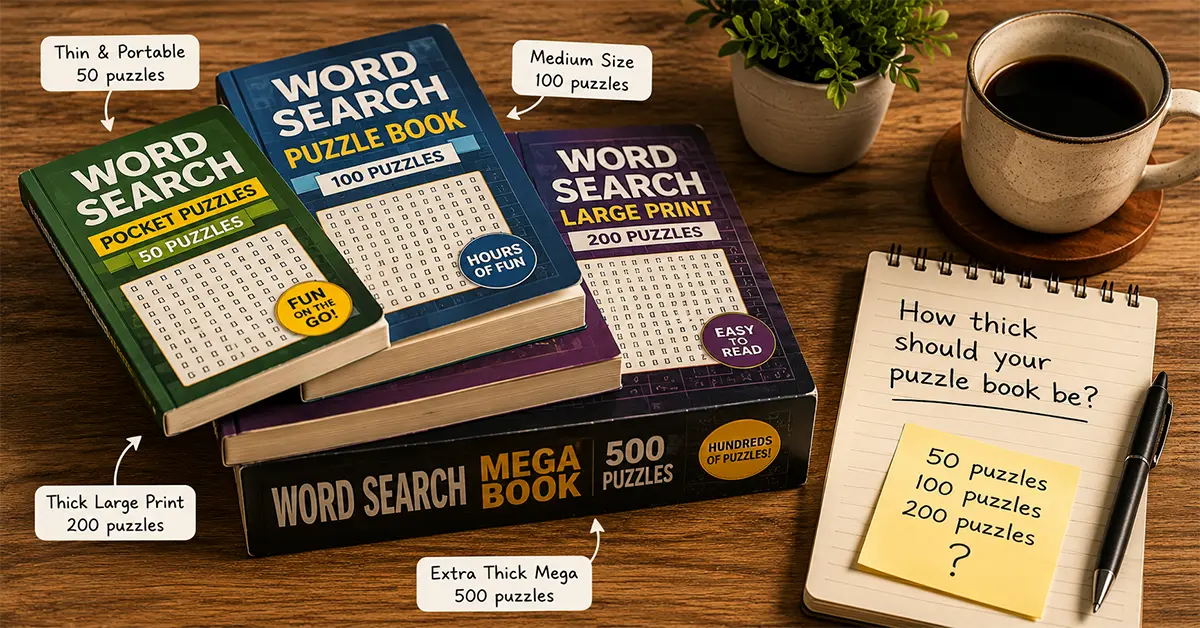
How many puzzles a KDP puzzle book should have depends on format, trim, and price: word search, sudoku, crossword, and maze books use different density. Check print cost in the KDP royalty calculator after you lock page count, and keep answer keys readable with solution page standards.
Puzzle count is a deceptively strategic decision. It looks like a simple question, "how many puzzles per book?", but the answer shapes your royalty margin, your price positioning, your KDP page minimum compliance, your buyer satisfaction, and your series architecture.
Too few puzzles and your book feels thin, underpriced, and hard to justify to buyers who compare page counts in Amazon search. Too many and your production time per title stretches, print costs rise, and you price yourself above your natural market.
This guide gives you a concrete framework: what the published standards look like by puzzle type, how page count connects to trim size and royalty, how to position puzzle count for different audiences and price points, and what the data from bestselling KDP puzzle books actually shows.
See also: trim size before puzzle count, KDP royalty calculator guide, and Sudoku book page density.
Why Puzzle Count Is a Competitive Positioning Decision
Before you decide on a puzzle count, understand what it signals to buyers:
Puzzle count communicates value. "200 Sudoku Puzzles" on the cover title is a value signal. Buyers scanning search results compare puzzle counts the same way they compare page counts. A book with 50 puzzles competes differently from a book with 200, even at the same price.
Puzzle count affects KDP minimum page compliance. KDP requires at least 24 pages for a paperback. In practice, a legitimate puzzle book with front matter and a solution section will easily exceed this. But extremely thin books (under 100 pages) look insubstantial in Amazon search thumbnails and are harder to price profitably.
Puzzle count determines your series cadence. A 100-puzzle book takes X production time. A 200-puzzle book takes roughly 2X. If you are publishing one title per month, 100-120 puzzles per volume is more achievable than 200+.
More puzzles is not always better. A "500 Easy Sudoku" mega-volume competes in a different price tier from a "100 Hard Sudoku" expert edition. Both are viable. They are just different products for different buyers.
Puzzle Count Standards by Type
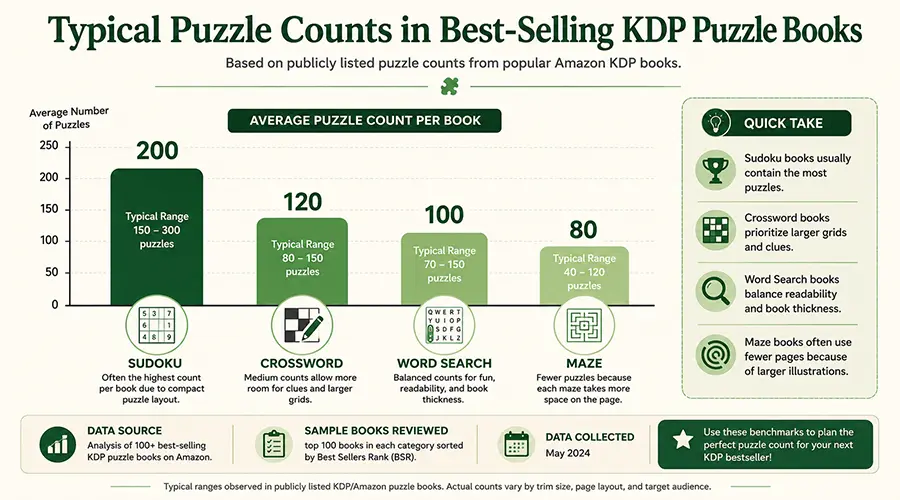
The benchmarks below are based on analysis of the bestselling titles in each category on Amazon KDP. Use these as your competitive baseline, not as hard rules.
Crossword Puzzle Books
Format | Puzzle Count Range | Note |
|---|---|---|
Standard adult (6x9) | 50-80 | Classic "one book" quantity; matches Dell/Simon & Schuster benchmarks |
Large format adult (8.5x11) | 80-120 | More page room per puzzle; 100 is a common round-number title claim |
Mega / premium (8.5x11) | 150-300 | "Jumbo" or "mega" positioning; price tier $14.99+ |
Easy / beginner (any trim) | 50-75 | Fewer puzzles = higher buyer satisfaction (less fatigue with easy content) |
Expert / hard (any trim) | 50-80 | Expert solvers prefer quality over quantity; fewer but more complex puzzles |
Crossword books have the lowest standard puzzle count of any major KDP puzzle type. This is because each crossword puzzle takes more page space than a sudoku grid, a full 15x15 American crossword with two columns of clues fills most of a 6x9 page.
Sudoku Books
Format | Puzzle Count Range | Notes |
|---|---|---|
Standard adult (6x9) | 100-200 | The "200 puzzles" claim is a common title anchor in top sellers |
Large print / seniors (8.5x11) | 80-120 | Grid size increases per puzzle; 100 is the sweet spot |
Expert / hard (any trim) | 100-150 | Harder puzzles still get one puzzle per page standard |
Mega volumes (8.5x11) | 300-500 | "500 Sudoku Challenges" is a proven mega-volume title formula |
Pocket (5x8) | 150-300 | Small pages; smaller grids allow more per page |
Sudoku is the high-count category. Buyers expect 100+ puzzles as a baseline. A 50-puzzle sudoku book at the same price as a 200-puzzle competitor loses on perceived value unless it has a significant differentiator (luxury design, niche theme, special format).
Word Search Books
Format | Puzzle Count Range | Notes |
|---|---|---|
Standard adult (6x9) | 50-80 | One puzzle per page standard for adult word search |
Large print / seniors (8.5x11) | 40-60 | Larger grid size reduces count; accessibility is the differentiator |
Kids / themed (8.5x11) | 40-60 | Themed word search books often include illustrations |
Mega volumes | 100-150 | "100 Word Search Puzzles" is a common mega-volume format |
How Puzzle Count Connects to Page Count
Puzzle count alone does not determine your KDP page count. You also need to account for:
Front matter pages: Title page, copyright page, introduction, table of contents = typically 4-8 pages
Blank pages: KDP often requires even page counts; you may add 1-2 blank pages
Solutions section: The answer key at the back adds pages based on how compact your solution layout is
Page count formula:
Total Pages = Front Matter + (Puzzles x Pages Per Puzzle) + Solution Pages
Pages per puzzle by type:
Crossword (6x9, American 15x15): 1 page per puzzle (sometimes 1.5 if clues overflow)
Sudoku (standard): 1 page per puzzle
Sudoku (large print): 1 page per puzzle (larger grid)
Word search (standard): 1 page per puzzle
Maze (full-page adult): 1 page per puzzle
Maze (easy kids): 0.5 pages (2 per page common)
Solution pages:
Crossword solutions: typically 1 solution takes a full page; 80-puzzle book = ~80 solution pages unless compact
Sudoku solutions: compact; 4-6 per page standard; 100-puzzle book = 17-25 solution pages
Word search solutions: 1 per page standard; 60-puzzle book = 60 solution pages (can compact to 2/page)
Maze solutions: compact; 4-6 per page; 80-puzzle book = 13-20 solution pages
Example: 100-puzzle sudoku book at 6x9:
Front matter: 6 pages
Puzzles: 100 pages
Solutions (6/page): 17 pages
Filler to even page count: 1 page
Total: ~124 pages
How Puzzle Count Affects Your Royalty
KDP's print cost per book depends on page count. More pages = higher print cost = lower royalty at the same price (or requirement to charge more).
Key principle: Every puzzle you add costs you a fraction of a cent in print cost. But it also increases your perceived value, allowing you to charge more.
The optimal range is where your puzzle count is high enough to justify your target price, but not so high that your print cost eats your royalty.
Examples at 6x9, B&W, white paper:
Puzzle Count | Approx. Pages | Print Cost | Royalty at $9.99 | Royalty at $12.99 |
|---|---|---|---|---|
50 crossword | ~120 pages | ~$2.65 | $3.34 | $5.14 |
100 sudoku | ~125 pages | ~$2.76 | $3.23 | $5.03 |
150 sudoku | ~175 pages | ~$3.69 | $2.30 | $4.10 |
200 sudoku | ~225 pages | ~$4.62 | $1.37 | $3.17 |
300 sudoku | ~330 pages | ~$6.54 | N/A | $1.25 |
This table shows that above 200 puzzles in standard format, royalties erode unless you price significantly higher. This is why "mega" volumes (300-500 puzzles) tend to price at $14.99+ and use larger trim sizes where print cost is higher but buyer willingness to pay is also higher.
Puzzle Count by Audience and Positioning
Beyond competitive benchmarks and page math, tailor puzzle count to your specific audience.
Beginners and casual buyers: Less is more. A 50-puzzle easy crossword book feels achievable. A 200-puzzle easy crossword book feels daunting. Completion drives satisfaction and repeat purchase. For beginners, 50-75 puzzles per volume encourages "I finished it!" moments that lead to Vol. 2 purchases.
Experienced solvers: Quality over quantity. Hard sudoku and expert crossword buyers care more about puzzle validity and genuine difficulty than raw count. 75-100 well-calibrated hard puzzles outperforms a bloated 200-puzzle "hard" book where half the puzzles are too easy.
Seniors and accessibility-focused buyers: Match count to usability. A 60-puzzle large-print sudoku book is fine. Seniors are not racing through volumes at the pace of adult enthusiasts. They want clean, readable puzzles at a pace they enjoy.
Gift buyers: Round numbers and volume claims matter. "100 Puzzles" and "200 Puzzles" are cleaner title claims than "87 Puzzles." Gift buyers scan for impressive-sounding round numbers. Round your puzzle count to the nearest 25 or 50.
Mega-volume buyers (value positioning): These buyers want the highest puzzle count for the lowest price per puzzle. 300, 400, or 500 puzzles with a proportionally priced book wins this segment.
How to Set Puzzle Count in RodBooks
When you build a puzzle book in RodBooks, puzzle count is set in Step 2 (Book settings). Enter your target puzzle count and the platform configures:
Total page count (shown in the preview)
Solution section depth (based on solutions-per-page setting)
Front matter pages
The live page preview in Step 3 shows you the exact book thickness at your chosen count. You can adjust before export to hit your target page count for royalty calculation.
Configure your puzzle count in RodBooks →
Frequently Asked Questions
Does KDP have a minimum puzzle count?
KDP has a minimum page count of 24 pages, not a minimum puzzle count. In practice, any legitimate puzzle book with front matter and solutions will exceed 24 pages. Focus on the royalty-optimal page range rather than the minimum.
Can I list the puzzle count in my KDP title?
Yes, and you should. "100 Sudoku Puzzles" or "200 Crossword Challenges" in the title or subtitle is a proven conversion signal. It helps buyers compare value at a glance in search results.
What happens if my puzzle count doesn't divide neatly into my page count?
Add blank pages at the back (before or after the copyright page) to reach an even number. KDP requires even page counts for paperbacks. Blank pages also protect the solution section from showing through the back cover.
Should I use the same puzzle count for every volume in a series?
Generally yes, for consistency. Buyers who buy Vol. 2 after Vol. 1 expect similar length and value. Deviating significantly (e.g., Vol. 1 has 100 puzzles, Vol. 2 has 50) without a price change will generate complaints.
Is there a maximum puzzle count KDP supports?
KDP supports paperbacks up to 828 pages. A 500-puzzle sudoku book at 1 puzzle per page with solutions would be roughly 580 pages, well within the limit. For practical production and pricing, most publishers cap at 300-500 puzzles.