How to Create Sudoku Books for Amazon KDP
How to create sudoku books for Amazon KDP: choose a difficulty niche, generate valid puzzles with solutions, format a print-ready interior, and optimize your listing.
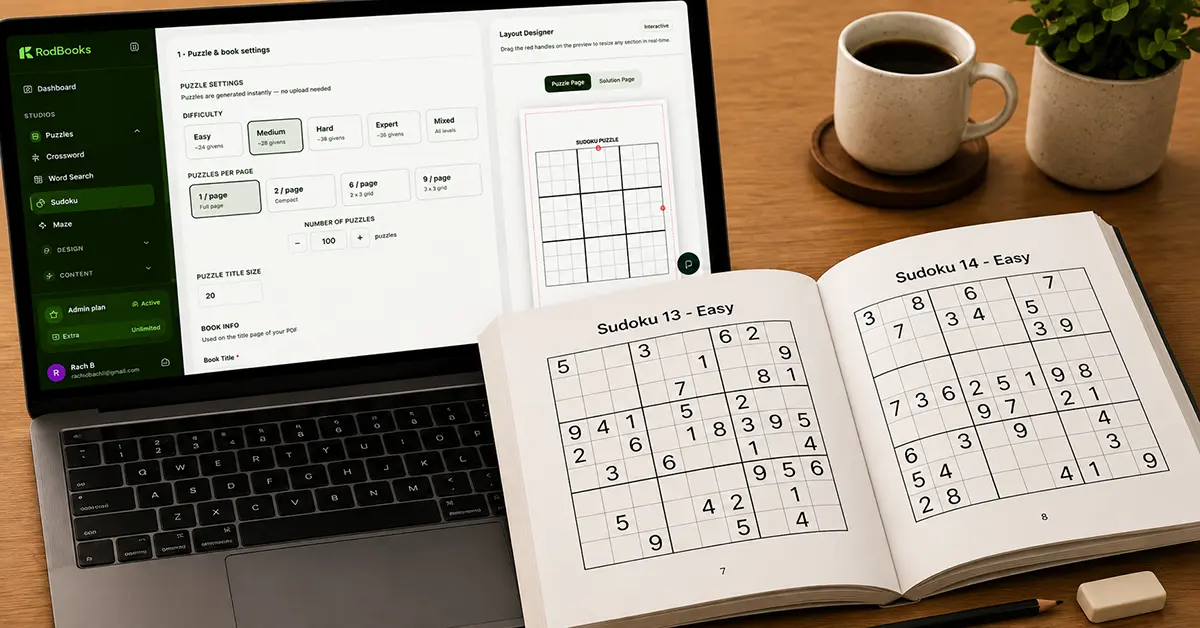
How to create sudoku books for Amazon KDP is a repeatable publishing workflow: pick a difficulty niche, generate valid grids with matching solutions, lock trim and page count, then publish a listing that matches what buyers search. Batch print-ready interiors in the RodBooks sudoku generator once your format is set. For puzzle-count ranges by format, see how many puzzles a KDP puzzle book should have.
Sudoku is one of the most searched puzzle categories on Amazon. Buyers return to it constantly, not because it is trendy, but because it is genuinely replayable. A new solver working through "Easy" puzzles will come back for "Medium" within weeks. An experienced solver looking for a daily challenge buys new volumes on a near-monthly basis.
For KDP publishers, this loyalty is the business case. Sudoku books are simple to differentiate by difficulty, audience, and volume number. They require no licensing, no narrative content, and no design beyond a clean interior and a strong cover. Once you have a production workflow that generates, formats, and exports print-ready files consistently, you can build a series that earns royalties indefinitely.
This guide covers everything: choosing a profitable sub-niche, generating valid puzzles, formatting a professional interior, designing a cover, optimizing your KDP listing, and scaling to a series. Keep difficulty labels honest on the cover and in Look Inside so Easy, Medium, and Hard volumes train the right buyers.
See also: crossword books in the same catalog, large-print formats for seniors, and Sudoku page count and royalties.
Why Sudoku Books Remain One of KDP's Most Reliable Niches
Demand is structural, not seasonal. Google Trends shows consistent year-round search volume for "sudoku book for adults" with moderate spikes in Q4 (gift buying) and Q1 (new year routines). Unlike novelty niches, sudoku never goes out of style.
Difficulty creates a natural series engine. A buyer who finishes your "Easy" volume will search for your "Medium" volume next. Series momentum is built into the product category.
Large-print variants double your addressable market. "Large print sudoku for seniors" is a distinct sub-niche with its own search traffic, buyers, and review patterns. One generator workflow can produce both standard and large-print editions with a typography change.
Low returns and high satisfaction rate. Sudoku buyers review based on print quality and clue accuracy. A clean, legitimate puzzle grid with correct difficulty grading earns 4-5 star reviews reliably.
Step 1: Research and Select Your Sub-Niche
Don't publish "sudoku book." Publish into a specific position:
High-opportunity sub-niches:
Easy Sudoku for Adults / Beginners: large buyer pool, lower barrier to write clues, strong gifting signal
Large Print Sudoku for Seniors: premium pricing, loyal buyers, accessibility is the differentiator
Hard / Expert Sudoku: smaller but highly engaged niche; buyers are vocal reviewers when difficulty is authentic
Sudoku for Kids: educational angle; teacher purchase signal and parent gift intent
Pocket Sudoku (5×8 trim): travel-ready format, impulse-purchase price point
Jumbo / 500-puzzle Mega Volumes: "value" positioning, higher perceived ROI for the buyer
Research process:
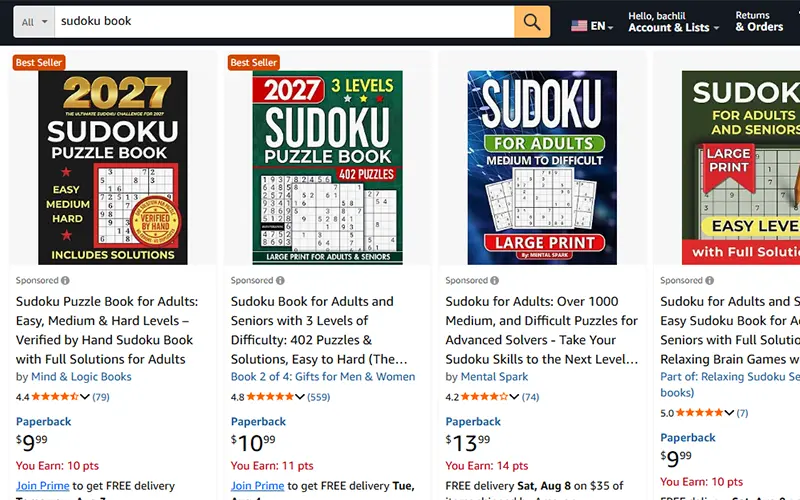
Search "sudoku book" on Amazon Books. Open the first 15 results. Record their BSR, review count, review date of the most recent review, and price.
Find any sub-niche with fewer than 200 reviews on the #1 listing. That is an entry opportunity.
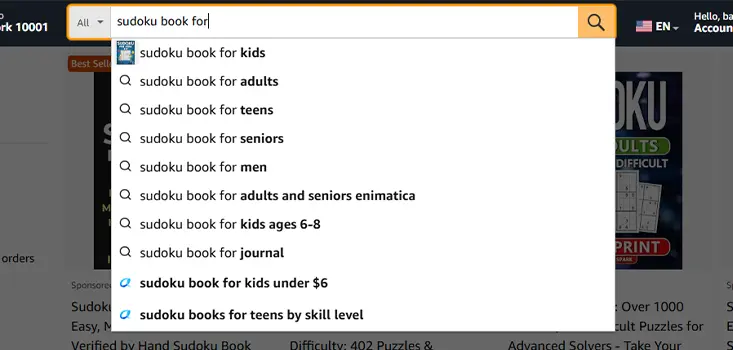
Look at autocomplete on Amazon: "sudoku book for ___" fills with audience phrases that map directly to title positioning.
Validate on Google: use Google Keyword Planner or similar to confirm search volume for your proposed title keyword.
Step 2: Generate Valid Sudoku Puzzles
Sudoku has strict mathematical constraints: every row, column, and 3×3 box must contain the digits 1-9 exactly once, with exactly one valid solution. Manually constructing valid puzzles is time-consuming and error-prone. Generating them with a tool designed for publishing is the only practical approach at book scale.
What Makes a Good KDP Sudoku Generator
A production-grade generator must:
Produce puzzles with exactly one solution (unsolvable or multi-solution puzzles are the #1 reader complaint in sudoku reviews)
Match the stated difficulty level consistently (an "Easy" puzzle that requires advanced techniques is a 1-star review waiting to happen)
Format the grid for print, not screen (adequate cell size, clean borders, clear number typography)
Support large-print variants without separate design work
Export complete books with front matter, puzzle run, and solution section, not just individual puzzle sheets
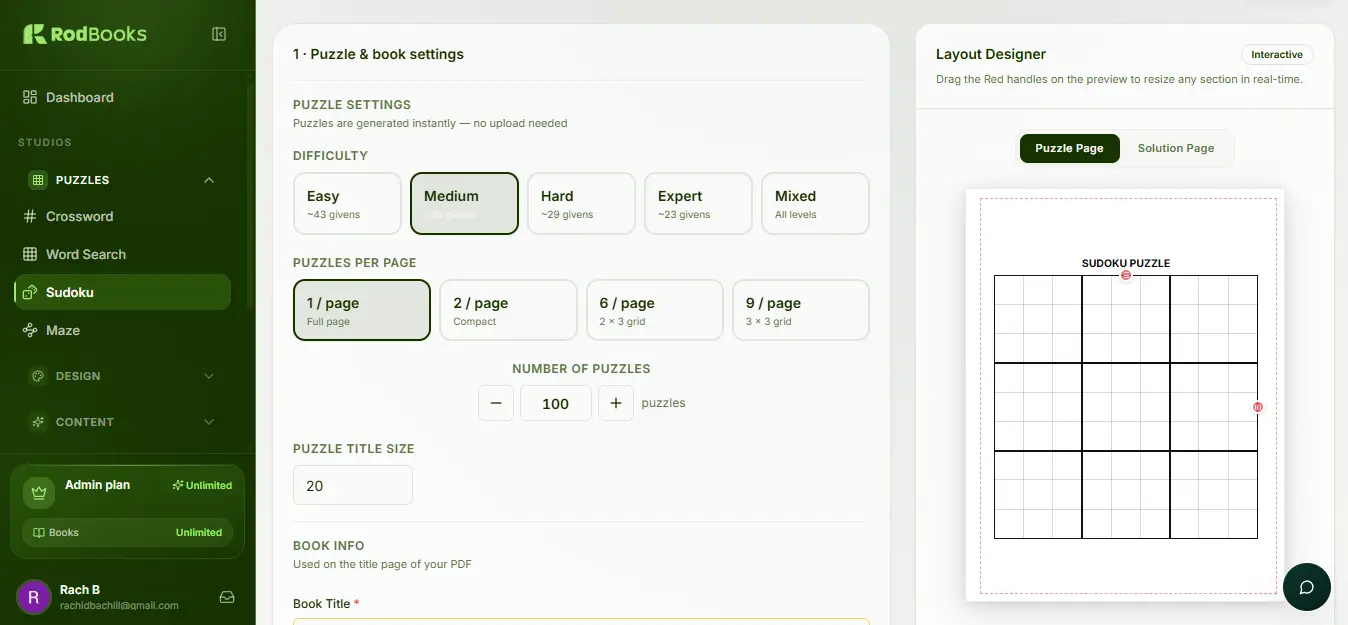
RodBooks Sudoku Generator handles all of these. Key capabilities:
- Difficulty levels: Easy, Medium, Hard, Expert, each calibrated to the number and placement of given clues
- Grid format options: Standard 9×9; configurable cell and number sizing for large-print output
- Book assembly: Set puzzle count, add front matter (title page, copyright, introduction, table of contents), configure solution density, and export one PDF
- Live page preview: See the exact page layout (grid size, spacing, margins) before export
- KDP-ready PDF: Vector output that stays sharp at print resolution
Difficulty Calibration: What Each Level Should Feel Like
Getting difficulty right is critical to reviews. Here is the buyer expectation by level:
Level | Given Clues (approx.) | Solving Techniques Required | Buyer Profile |
|---|---|---|---|
Easy | 36-45 | Naked singles only | Beginners, casual, seniors, gift buyers |
Medium | 27-35 | Hidden singles, basic pairs | Regular puzzle solvers |
Hard | 22-27 | Pointing pairs, box-line reduction | Experienced solvers |
Expert | 17-22 | X-wing, swordfish, advanced chains | Serious solvers only |
Step 3: Build Your Interior Structure
A professional sudoku interior has a clear, predictable structure. Buyers have established expectations from traditionally published sudoku books (Dell, Nikoli, Will Shortz editions). Match those expectations.
Standard interior structure:
Section | Notes |
|---|---|
Title page | Title, subtitle, volume number, author/brand |
Copyright page | Year, publisher, rights notice |
Introduction (optional) | Brief solving tips or difficulty guide |
Table of contents (optional) | Puzzle number ranges and page refs |
Puzzle run | All puzzles in order, one per page standard |
Solutions section | Compact grids, 4-6 per page |
One puzzle per page is the standard for adult sudoku books. Some "Jumbo" editions fit 2 puzzles per page, which is acceptable for Easy/Medium levels but not for Hard/Expert (solvers need writing space for notes).
Puzzle count by trim and positioning:
6×9 in, standard: 100-150 puzzles (standard positioning)
6×9 in, large print: 60-80 puzzles (grid takes more space)
8.5×11 in, standard: 150-200 puzzles
8.5×11 in, large print: 100-130 puzzles
Jumbo / Mega volume: 300-500 puzzles across larger trim
Step 4: Design Your Cover
Sudoku book covers follow tighter conventions than other puzzle genres. Buyers scan fast. Your cover must communicate three things in under two seconds: puzzle type (sudoku), difficulty level, and audience.
Cover design principles for sudoku:
Lead with difficulty. "HARD" or "EASY" in the largest text on the cover is standard in the top-selling sudoku books. Don't bury difficulty in the subtitle.
Include a partial grid visual. A 9×9 grid fragment (filled in, stylized, or geometric) signals the product category immediately.
State the puzzle count. "200 Puzzles" or "500 Sudoku Challenges" on the front cover increases perceived value and appears in browsing.
Match your series system. Use a consistent color band or icon system across volumes (e.g., green = Easy, orange = Medium, red = Hard). Series visual cohesion drives cross-sell.
Large-print editions need clear labeling. "LARGE PRINT" must be prominent. This is the primary search filter for senior buyers.
Step 5: Upload and Configure Your KDP Title
Log in to kdp.amazon.com. Start a new paperback title.
Interior upload requirements:
PDF, no bleed for interior (trim-box equals page size)
Embedded fonts only
No interactive or editable layers
Margin minimums: 0.25 in (outside), 0.375 in (gutter up to 150 pages), 0.5 in (gutter 151-300 pages)
After upload, check in KDP Previewer:
Grid cells are square and uniform
Numbers sit centered in cells
Solution grids are readable (not under 6pt font)
Page numbers are consistent
No text is cut off near margins
Step 6: Write a Conversion-Optimized Listing
Title Formula
[Difficulty] Sudoku Puzzles [for Audience], Vol. [N]: [Puzzle Count] [Distinguishing Feature]
Examples:
Easy Sudoku Puzzles for Adults, Vol. 1: 200 Beginner-Friendly Grids with Solutions
Large Print Sudoku for Seniors, Vol. 2: 100 Big-Grid Puzzles with Full Answer Key
Hard Sudoku Puzzle Book, Vol. 1: 150 Challenging 9×9 Grids for Expert Solvers
Backend Keywords (7 slots, 50 chars each)
Cover search terms your title can't hold:
- sudoku puzzle book easy beginners
- large print sudoku seniors adults
- sudoku hard expert brain games
- daily sudoku book gift
- sudoku activity book travel
- 9x9 sudoku puzzle book adults
- brain teasers logic puzzles book
Categories
Books > Humor & Entertainment > Word Games > Sudoku
Books > Crafts, Hobbies & Home > Crafts & Hobbies > Puzzles
Request niche categories via Author Central: "Large-Print Sudoku" or "Sudoku for Adults" depending on positioning.
Step 7: Pricing, Launch, and Series Building
Price benchmarks:
6×9, 100-150 puzzles: $7.99-$9.99
6×9 large print, 60-80 puzzles: $9.99-$12.99
8.5×11, 150-200 puzzles: $9.99-$13.99
Jumbo 300-500 puzzles: $12.99-$16.99
Target the 60% royalty tier ($2.99+ price, under $9.99 for most standard volumes). Use Expanded Distribution only if you intend wider retail reach; it reduces your royalty per sale.
Launch strategy:
Publish Vol. 1 with A+ Content modules active.
Run Amazon Sponsored Products on exact-match keywords for 30 days at $5-$8/day. Collect purchase data.
Publish Vol. 2 within 60 days of Vol. 1. Cross-link in A+ Content.
At Vol. 3, you have enough review and sales history to rank organically on long-tail keywords.
Series naming convention:
Choose a brand name for your series (e.g., "Clarity Sudoku", "MindGrid Books") and use it consistently across all covers, titles, and author names. This builds brand recognition in Amazon search results.
Mistakes That Kill Sudoku Book Reviews
Multi-solution puzzles. If your generator allows unsolvable or multi-solution grids through, expect 1-star reviews within the first month. Always use a tool that validates uniqueness for every generated puzzle.
Mislabeled difficulty. A "Hard" book with Easy-level puzzles is the most common sudoku complaint on Amazon. Use a generator that calibrates difficulty by technique required, not just clue count.
Solution page too small to read. Squeezing 9+ solutions onto a page produces illegible grids. 4-6 solutions per page is the maximum for reader comfort.
No series plan. A single sudoku book earns modest royalties. A series of 5-10 volumes with consistent branding earns category authority and cross-sells automatically.
Ignoring the large-print opportunity. The seniors market is consistently underserved with quality large-print editions. Publishing a large-print variant of every standard volume doubles your title count with minimal extra work.
How RodBooks Makes Sudoku Book Publishing Systematic
RodBooks Sudoku Generator brings together puzzle generation, book assembly, and PDF export into one workflow:
Generate Easy through Expert puzzles with validated uniqueness
Configure standard or large-print grid sizing
Set trim size (6×9 or 8.5×11), puzzle count, and solution density
Preview the live page layout before export
Compile complete interior with front matter and answer key
Download one print-ready PDF for KDP
You can start with a free account and test the complete sudoku workflow before committing to a paid plan.
Start building your sudoku book →
Frequently Asked Questions
Do sudoku puzzles need to have exactly one solution?
Yes. A puzzle with zero solutions cannot be finished; a puzzle with multiple solutions can be "solved" with answers that don't match your answer key. Both generate legitimate complaints and 1-star reviews. Always generate puzzles from a tool that enforces unique-solution validation.
How many sudoku puzzles should be in a KDP book?
100-200 puzzles is the standard range for adult sudoku books. Large-print editions run 60-100. Jumbo volumes can go to 300-500. Match puzzle count to trim size so grids are not cramped and there is room for solving notes beside each puzzle.
Can I publish both standard and large-print versions of the same book?
Yes. KDP treats each trim size as a separate title with its own ASIN, listing, and royalty. Publishing standard and large-print variants under the same series doubles your listing presence for the same content work. Use the same puzzle set but change grid sizing and typography.
What paper type should I choose for sudoku interiors?
White paper (standard) is fine for sudoku. Cream paper gives a warmer feel and some publishers use it for premium positioning. Both are available on KDP. Large-print editions benefit from white paper for maximum contrast.
Is it worth running Amazon Ads for sudoku books?
Yes, especially in the first 60 days. Sponsored Products on exact-match keywords (e.g., "sudoku book hard") at moderate budgets ($5-$10/day) generate the initial sales history that feeds organic ranking. Once a title ranks in the top 5 for its keyword, ad spend can be reduced.
Can I use pen names for my sudoku books?
Yes. Most puzzle book publishers use brand names or pen names rather than personal names. A recognizable series brand like "Peak Mind Puzzles" is often more effective than a personal author name for search and shelf recognition.
Final Checklist Before Publishing
Sub-niche researched; target keyword confirmed with BSR validation
Difficulty level defined and accurately calibrated
All puzzles generated with unique-solution validation
Interior previewed in RodBooks studio (grid size, margins, solution pages all confirmed)
PDF exported and reviewed in KDP Previewer with no errors
Cover PDF built with correct spine width for page count
Title follows difficulty + audience + volume formula
Subtitle contains primary keyword
7 backend keyword slots filled
2 categories selected
A+ Content module prepared
Price set for 60% royalty tier
Vol. 2 production started before Vol. 1 publishes