KDP Book Description Formula That Converts
The 5-part KDP book description formula for puzzle books: hook, proof bullets, credibility, audience fit, and CTA, plus HTML formatting and fill-in templates.
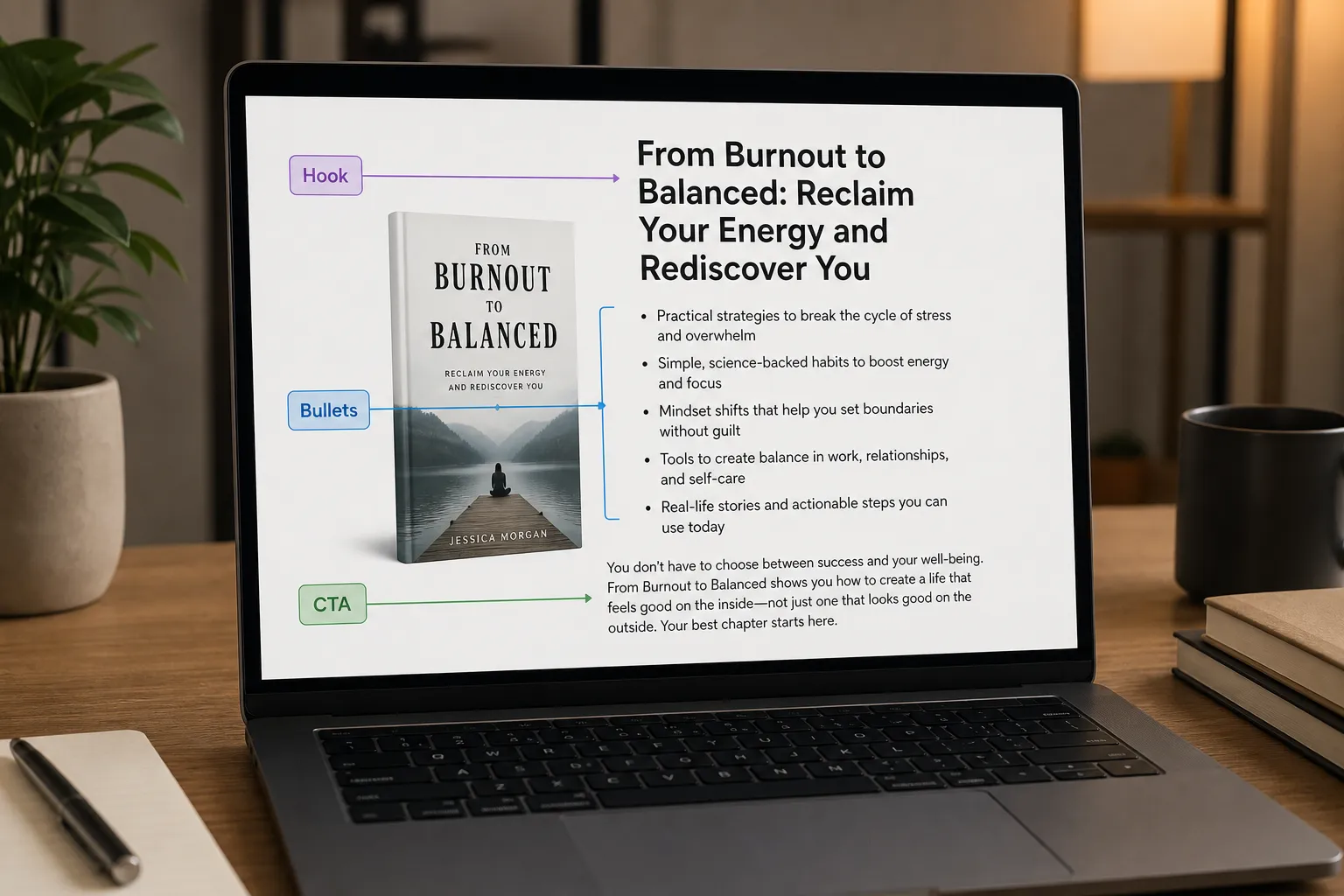
The KDP book description formula turns a wall of text into a scannable pitch buyers can trust in under 30 minutes. Use this full formula guide for puzzle books, then paste a draft into the description generator when you want a formatted starting point.
The Amazon KDP book description is the second thing a buyer reads after deciding your cover is worth clicking. It runs approximately 4,000 characters and appears on the product page between the book's editorial reviews and product details section. Most buyers do not read all of it. They scan. They look for confirmation signals that the book will deliver what the cover and title promised.
A conversion-optimized KDP description is not a creative writing project. It is a structured persuasion document with specific sections performing specific jobs. Once you understand the formula, you can write a high-converting description for any puzzle book in under 30 minutes.
This guide covers: how Amazon displays descriptions (and what buyers actually see), the complete 5-part description formula, HTML formatting that works in KDP, psychological trigger words that convert, and complete fill-in templates for puzzle books.
See also: title and subtitle formulas, backend keywords for puzzle books, and Amazon A+ Content module sizes.
How Amazon Displays Your Description
Before writing, understand the display mechanics:
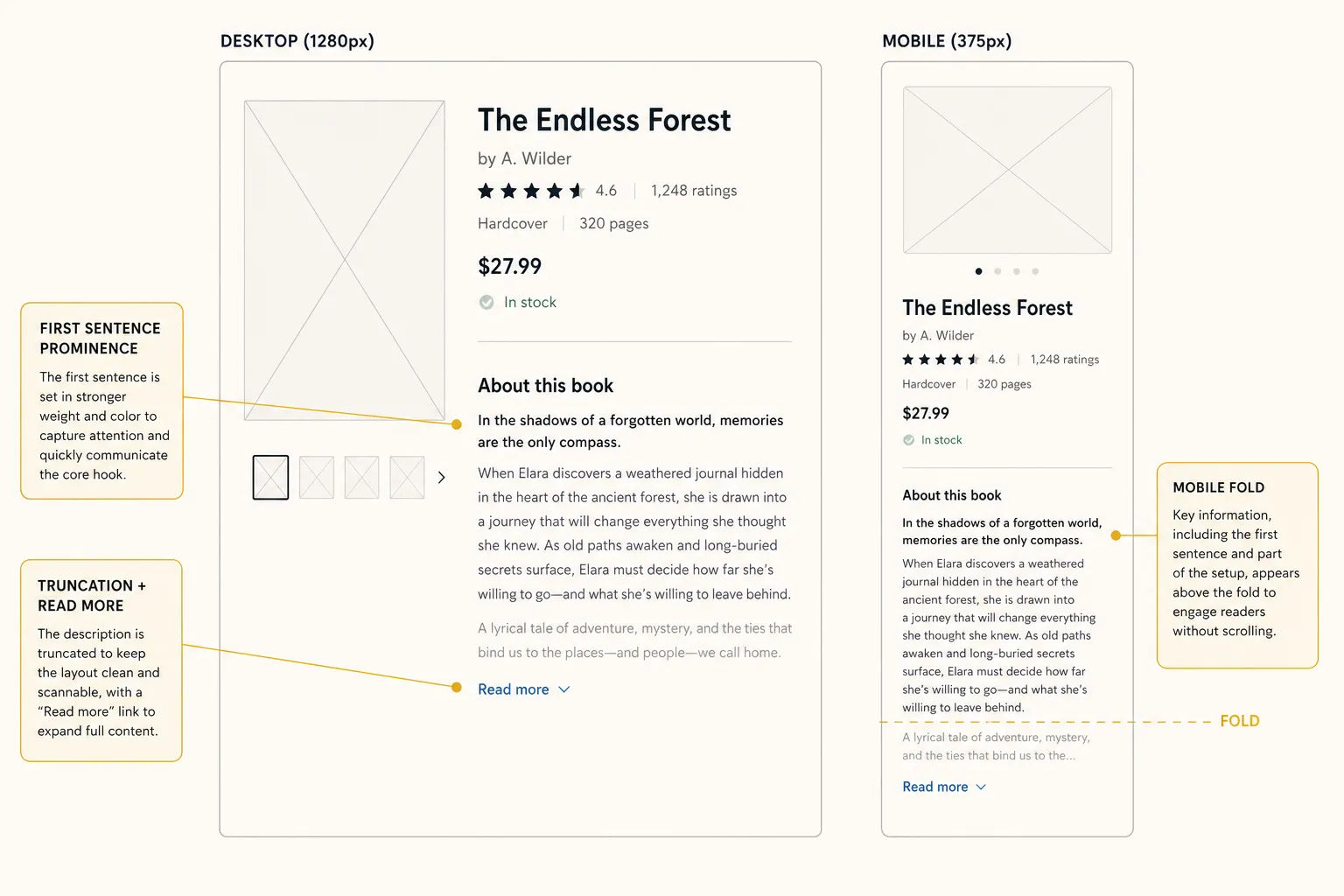
Desktop: Amazon shows approximately the first 1,000 characters of your description before truncating with a "Read more" link. The content above this fold is your highest-priority real estate.
Mobile: The fold is even shorter on mobile, approximately 600-700 characters visible before truncation. Given that 60%+ of Amazon shopping happens on mobile devices, your first two sentences must work as a standalone mini-pitch.
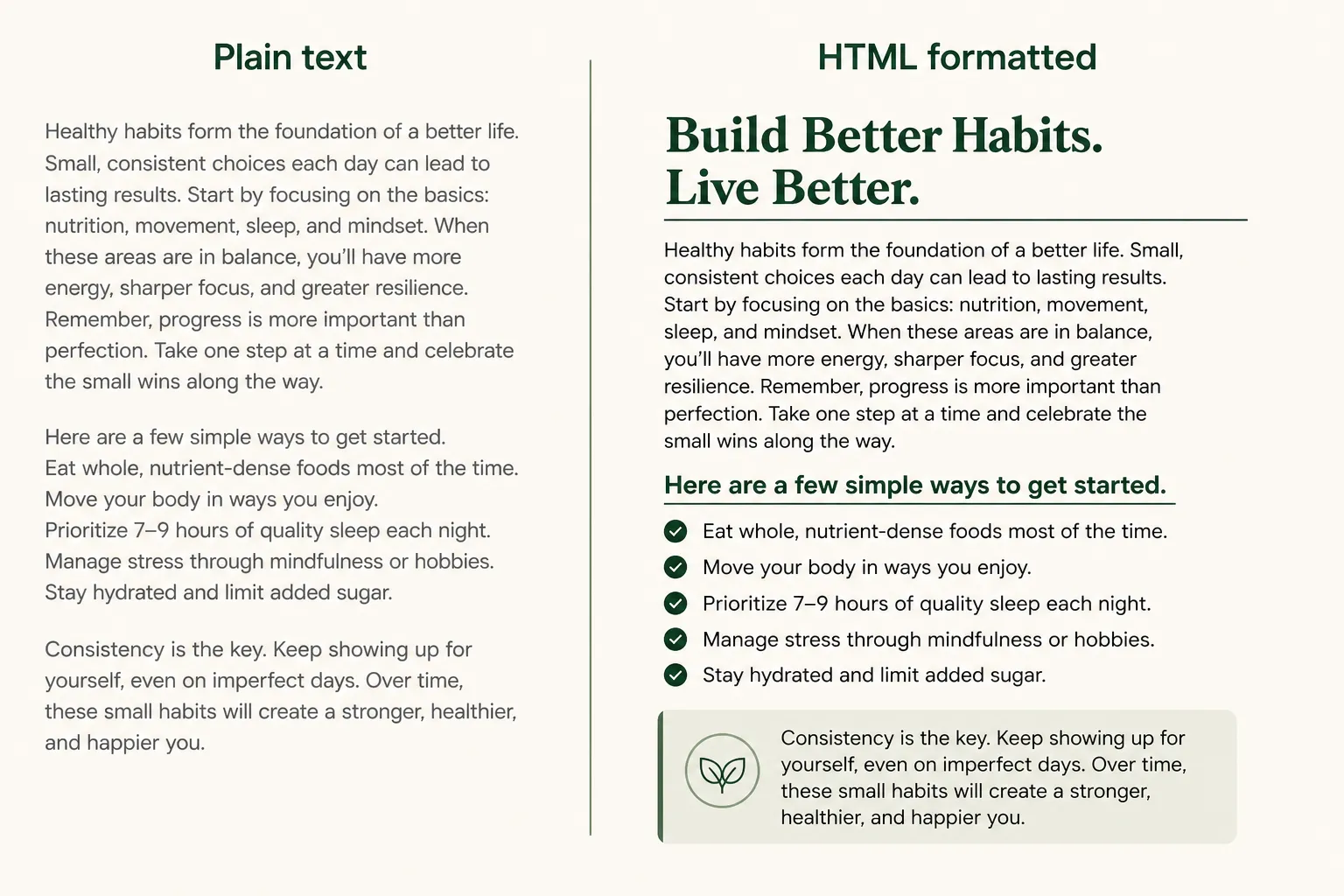
HTML formatting is supported (and important): KDP descriptions support a limited subset of HTML tags. Using them properly creates visual hierarchy that makes your description more scannable and professional. Not using them results in a wall of plain text that buyers skip.
Supported HTML tags in KDP descriptions:
<b>, bold text<em>, italic text<br>, line break<ul>/<li>, bulleted list<ol>/<li>, numbered list<h3>, sub-heading (limited support)<p>, paragraph
Tags not supported (will show as literal text): <strong>, <h1>, <h2>, <div>, any CSS, links.
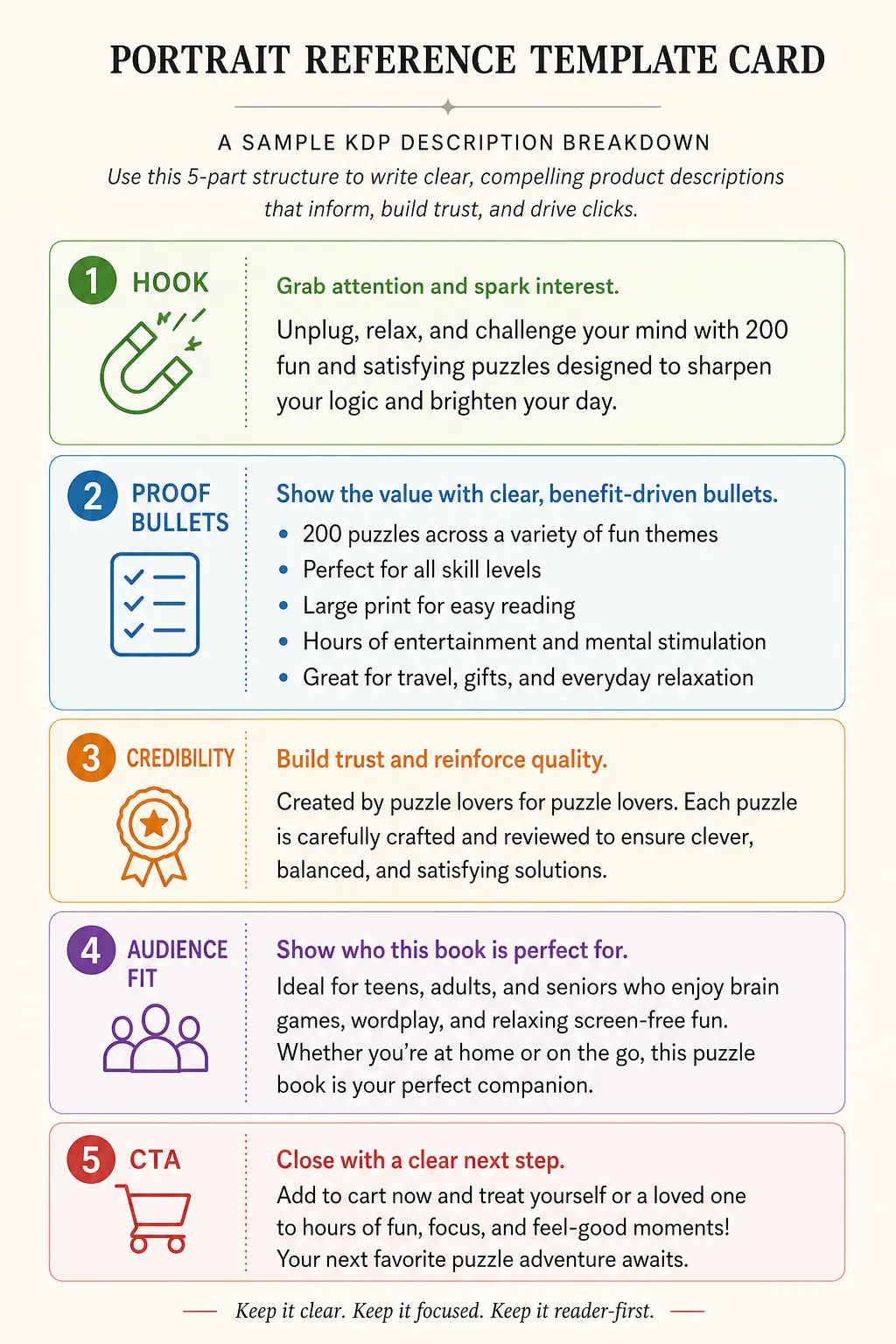
The 5-Part KDP Description Formula
This formula works for all puzzle and low-content book types. Each part has a specific conversion job.
Part 1: The Hook (lines 1-2, ~150 characters)
Job: Give buyers above the mobile fold a reason to keep reading. Confirm the book delivers exactly what the cover and title promised.
Formula: [Specific claim about what the buyer gets] + [Primary benefit or differentiator]
Rules:
- Do NOT start with the book title, start with the buyer benefit
- Do NOT use vague adjectives ("amazing", "wonderful"), use specifics
- Lead with the strongest singular claim
Examples:
- 60 professionally crafted American-style crossword puzzles in one clean, print-ready volume, no filler, no reprints.
- Large print. Real challenge. 100 sudoku puzzles designed for adults who want to think, not squint.
- Every word search in this collection is built around birds, 400 species names, migration terms, and birdwatcher vocabulary, puzzles you won't find anywhere else.
Part 2: The Proof Block (3-5 bullet points)
Job: Rapidly communicate the key product features that matter to buyers in this niche. Bullets are scanned, not read; each bullet must carry value independently.
Formula for each bullet: [Feature], [benefit or specification]
Rules:
- 3-5 bullets maximum. More than 5 and buyers stop reading.
- Start each bullet with the feature, not a verb ("80 puzzles" not "Includes 80 puzzles")
- Be specific: puzzle count, difficulty level, trim size, paper color, grid style, solution format
- At least one bullet should address the most common buyer objection or concern
Example bullets for a sudoku book:
• 100 Medium-difficulty sudoku puzzles, calibrated for solvers who are past easy but not yet expert level
• One puzzle per page, full-size 9x9 grid with room to write notes alongside each puzzle
• Complete solutions section, 6 compact answer grids per page at the back of the book
• 6 x 9 in paperback format, fits in a bag, reads like a real book, not a printout
• Great for commuters, travelers, or a daily brain workout at home
Part 3: The Credibility / Process Statement (1 short paragraph)
Job: Build confidence in the product quality. This is where you address how the puzzles were made, validated, or curated, briefly.
Formula: [How puzzles were created or validated] + [what that means for the buyer]
Rules:
- Keep it to 2-3 sentences maximum
- This is NOT a biography of you as the author, buyers don't care about your background
- Focus entirely on what the production quality means for their experience
Examples:
- Every puzzle in this collection was generated with a dedicated KDP puzzle studio and reviewed for layout before export, so the pages open flat, the grids print cleanly, and the solutions match every time.
- All word lists were curated specifically for this collection, no generic filler, no repeated themes from volume to volume.
Part 4: The Audience Fit Statement (2-3 sentences)
Job: Help buyers self-qualify. Tell them explicitly who this book is for, this increases conversion among the right audience and prevents purchases (and returns) from the wrong audience.
Formula: This book is for [specific audience description]. [Specific use case]. [Emotional payoff]
Examples:
- This book is for adults who want a genuine crossword challenge without the confusing clue style of newspaper puzzles. Whether you solve during your commute, your lunch break, or a quiet evening, each puzzle is ready when you are.
- Perfect for seniors who prefer puzzles with genuinely large print and familiar, comfortable themes. A thoughtful gift for parents, grandparents, or anyone in your life who enjoys a relaxing daily puzzle.
Part 5: The Closing CTA (1-2 sentences)
Job: Create a mild urgency or decisional nudge. Amazon's "Look Inside" button is your competition, this CTA should encourage an immediate purchase decision, not a research detour.
Formula: [Action phrase] + [primary value restatement]
Rules:
- Do not use "buy now", it sounds desperate
- Do not use promotional language ("limited time", "sale price")
- Use directional phrases: "Scroll up and add to cart", "Grab your copy today", "Click Add to Cart"
Examples:
- Scroll up and add to cart, 60 clean, well-crafted crossword puzzles are waiting.
- Click Add to Cart and start solving today, your next favorite puzzle book is one click away.
- Order now and give yourself (or someone you love) a puzzle book worth finishing.
Complete Fill-In Template
Copy this template and fill in the bracketed sections:
[BOLD: ONE SENTENCE HOOK, specific claim about what buyer gets + differentiator]

[Paragraph, 2-3 sentences expanding the hook: what makes this collection different,
what the buyer will experience when they open it]

• [Puzzle count + difficulty level], [specific detail]
• [Format feature], [benefit to the reader]
• [Solution section detail], [format and placement]
• [Physical format], [trim size, paper, or portability benefit]
• [Audience fit or use case], [emotional or practical benefit]

[1 paragraph, how the puzzles were created/validated and what that means for quality]

[1-2 sentences, who this book is specifically for + primary use case]

[1 sentence CTA, directional action phrase + value restatement]
Psychological Triggers That Improve Description Conversion
Beyond structure, certain words and phrases consistently increase conversion in puzzle book descriptions. Use these deliberately.
Specificity over vagueness:
- "60 puzzles" beats "dozens of puzzles"
- "American-style 15x15 grid" beats "classic crossword format"
- "6 compact solutions per page" beats "solutions included"
Sensory and experiential language:
- "pages open flat", tactile comfort signal
- "grids print cleanly", quality reassurance
- "room to write notes", imagines the solving experience
Audience mirroring:
Use the exact language your target buyer uses. Senior word search buyers say "big letters" not "enlarged typography." Crossword solvers say "Across and Down clues" not "directional word placements." Mirror the buyer's vocabulary.
Implied quality standards:
- "no filler", signals curated quality
- "no reprints", signals originality
- "professionally laid out", signals production care
- "designed specifically for [audience]", signals intentional product
Completion framing:
Puzzle buyers respond to completion language. "All 60 puzzles with solutions" (complete), "nothing left out" (complete), "everything you need in one book" (complete). Completion = value = purchase confidence.
What to Avoid in KDP Descriptions
Starting with the book title. Amazon already displays your title above the description. Don't repeat it, start with a buyer benefit.
Writing about yourself. "I have been making puzzles for 10 years" has zero impact on most puzzle book buyers. Lead with the product, not the creator.
Vague quality claims. "The best crossword book you'll ever buy" is meaningless and against Amazon guidelines. Use specifics instead.
Long, unbroken paragraphs. On mobile, a 200-word paragraph is invisible, buyers scroll past it. Use the HTML structure and keep paragraphs under 4 sentences.
Keyword stuffing. Repeating your main keyword phrase 8 times makes the description unreadable. Use keywords naturally, once or twice in the description is sufficient.
Missing the CTA. Descriptions without a closing call to action lose buyers at the decision point. The CTA does not have to be aggressive, just directional.
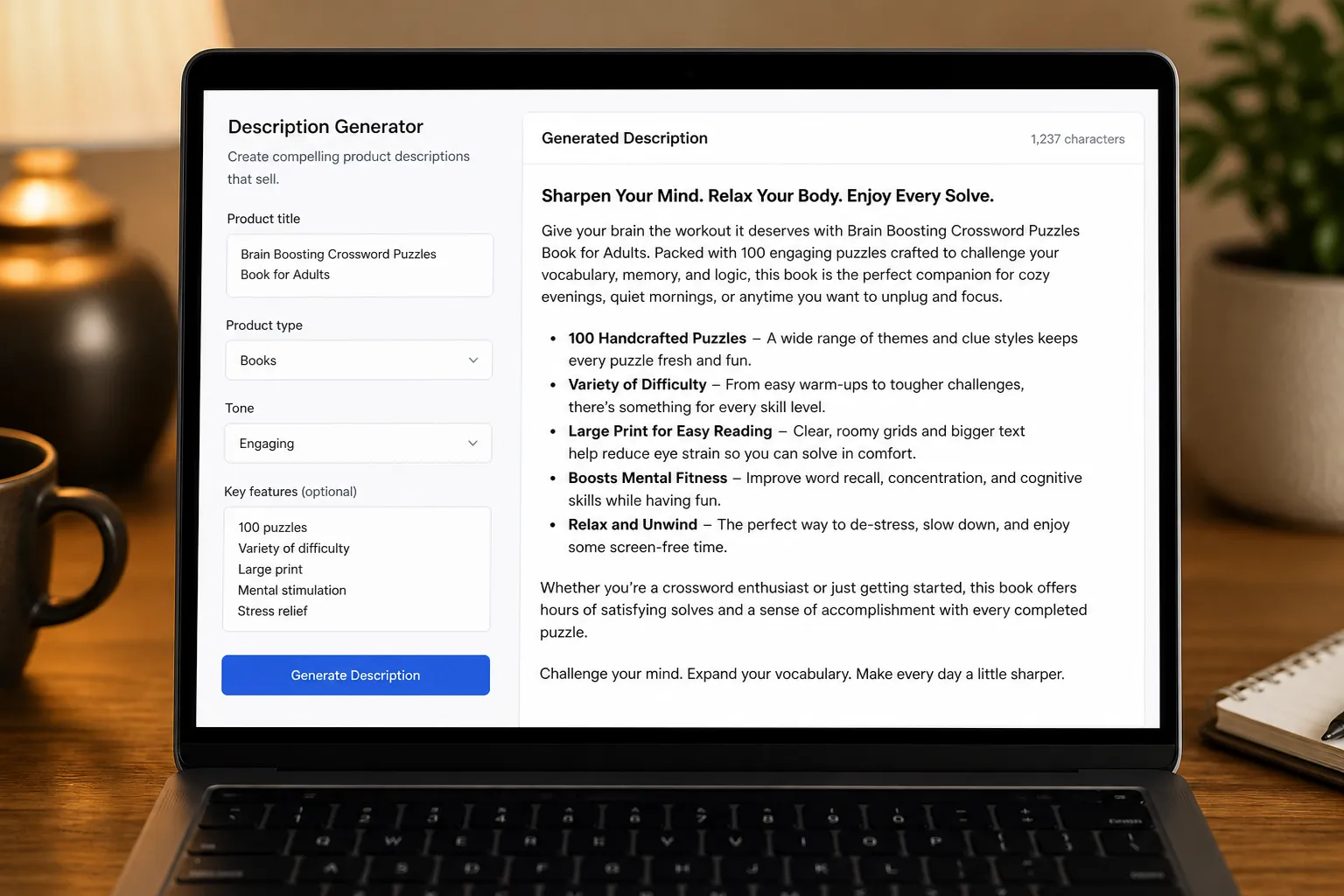
Using RodBooks Description Generator
RodBooks Description Generator applies the formula above to your specific book type, audience, puzzle count, and features, and outputs an HTML-formatted description ready to paste into KDP.
Generate your book description →
Frequently Asked Questions
How long should a KDP book description be?
Amazon allows up to 4,000 characters. Aim for 1,500-2,500 characters, enough to cover all 5 formula parts with detail, without padding to fill space. Longer descriptions can dilute your key messages.
Do keywords in descriptions help ranking?
Yes, moderately. Amazon's algorithm indexes your description, so including your primary keyword phrase naturally (once or twice) in the description contributes to search relevance. However, title and backend keywords are weighted more heavily than description keywords.
Should I use A+ Content instead of a long description?
Use both. A+ Content is a visual module that appears below the description on the product page. It does not replace the description, it supplements it with images and formatted sections. Both contribute to conversion. Descriptions rank in Amazon search; A+ Content converts browsers into buyers.
Can I copy my description to other titles in my series?
No, each title needs a unique description. Amazon's duplicate content detection can flag identical descriptions as policy violations. Templates are fine to reuse as structural frameworks, but the specific details (puzzle count, theme, difficulty) must be unique to each title.
Description Writing Checklist
- Hook in first 150 characters (visible above mobile fold)
- No book title at the start
- 3-5 bullet points with specific features
- Each bullet is specific (numbers, format, placement)
- One credibility/process statement included
- Audience fit statement included
- Closing CTA included
- HTML formatting applied (bold, bullets, line breaks)
- Total length 1,500-2,500 characters
- No prohibited claims (no "best", "top-rated", competitor names)
- Primary keyword appears naturally once or twice