KDP Title and Subtitle Formulas for Puzzle Books
KDP title and subtitle formulas for puzzle books: proven patterns for word search, sudoku, and crossword listings, plus trademark checks.
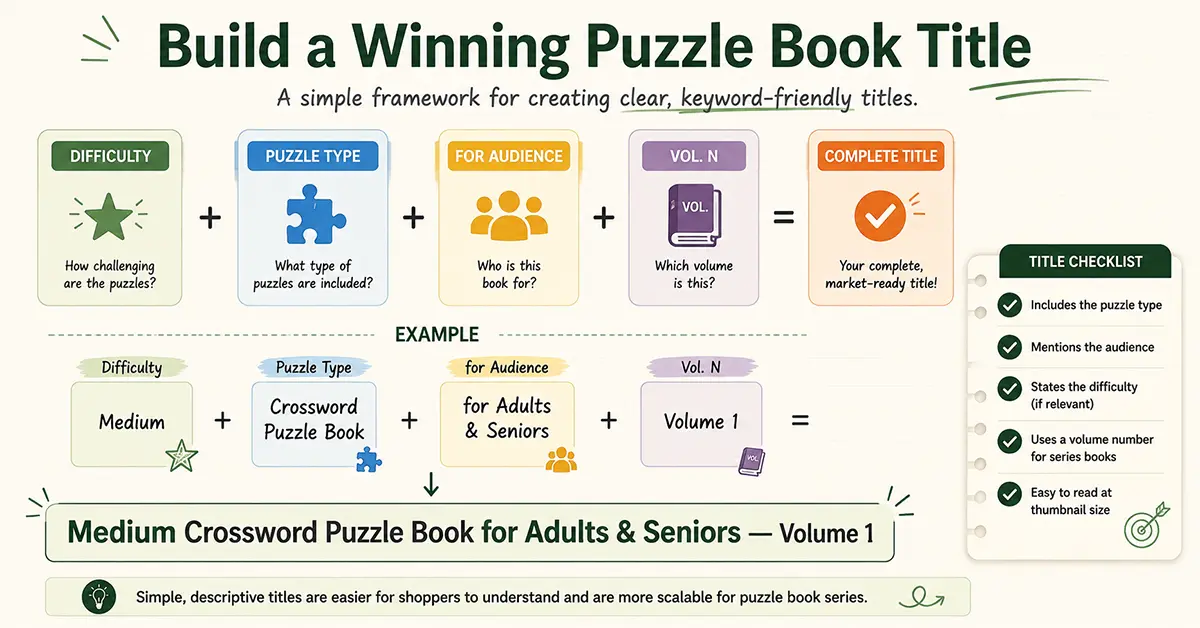
KDP title and subtitle formulas for puzzle books follow a simple pattern: format + audience + proof (count, large print, difficulty). Draft angles in the title generator, then screen distinctive words with the trademark risks guide before you lock a cover.
Your book's title is the highest-weighted piece of text in Amazon's search index. It is the first thing a buyer reads, the primary search signal Amazon uses to rank your book, and the cover element that either earns a click or loses one. Getting it wrong costs you search visibility. Getting it right compounds, a well-optimized title earns organic ranking that generates sales for years.
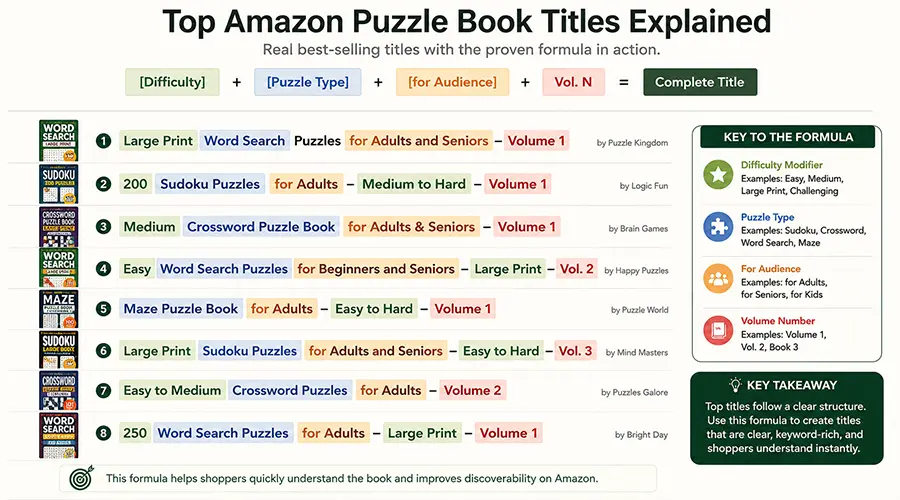
The good news: puzzle book titles follow predictable, proven formulas. The bestselling titles in every puzzle niche use consistent structural patterns that are easy to replicate, adapt, and scale across a series. This guide gives you those formulas, with specific examples for word search, sudoku, crossword, and maze books, plus the subtitle strategy that closes the keyword gap your title leaves.
See also: book description formula, backend keyword examples, and cover design for puzzle books.
How Amazon Indexes Your Title
Amazon's algorithm reads your title as its primary relevance signal. Title words carry more weight than subtitle words, which carry more weight than description words. This creates a clear priority order for keyword placement:
Primary title: Put your highest-value keyword phrase here. The phrase a buyer is most likely to type into Amazon search when looking for your specific book.
Subtitle: Put your second-tier keywords here, audience variants, feature claims, and puzzle count. The subtitle is indexed but weighted slightly lower than the primary title.
Author name: Not indexed for search relevance (buyers don't search by author for puzzle books).
Backend keywords: Indexed at roughly equal weight to subtitle, cover what didn't fit in title or subtitle.
KDP Title character limit: The title + subtitle combined should not exceed 200 characters. In practice, effective puzzle book titles are 60-120 characters for the full title+subtitle combination.
The Universal Puzzle Book Title Formula
Before type-specific formulas, understand the universal structure that underlies all successful puzzle book titles:
[Difficulty or Adjective] + [Puzzle Type] + [for/by Audience] + [Volume N] : [Subtitle with Count + Feature]
Every element has a job:
Element | Job | Examples |
|---|---|---|
Difficulty/Adjective | Sets buyer expectation, filters audience | Easy, Hard, Large Print, Medium, Expert |
Puzzle Type | Category signal, primary keyword | Crossword Puzzles, Sudoku Book, Word Search, Maze Book |
Audience | Self-qualification, gift signal | for Adults, for Seniors, for Kids, for Women |
Volume N | Series signal, repeat purchase trigger | Vol. 1, Book 2, Volume 3 |
Subtitle: Count | Value signal | 100 Puzzles, 60 Challenges, 200 Brain Teasers |
Subtitle: Feature | Differentiator, additional keyword | with Solutions, Large Print, American Style |
Not every title needs all elements, but removing any element without a reason usually weakens the title.
Crossword Book Title Formulas
Standard Adult Crossword
Primary formula:
[Difficulty] Crossword Puzzles for Adults, Vol. [N]: [Count] [Style] Challenges with Solutions
Examples:
Easy Crossword Puzzles for Adults, Vol. 1: 60 American-Style Challenges with Solutions
Hard Crossword Puzzle Book for Adults, Vol. 2: 75 Challenging Grids for Expert Solvers
Medium Crossword Puzzles for Adults, Vol. 3: 80 Classic American Crosswords
Senior / Large Print Crossword
Primary formula:
Large Print Crossword Puzzles for Seniors, Vol. [N]: [Count] [Easy/Medium] Puzzles with Big Letters
Examples:
Large Print Crossword Puzzles for Seniors, Vol. 1: 60 Easy Puzzles with Big Letters and Solutions
Large Print Crossword Book for Seniors and Adults, 50 Comfortable Puzzles with Large Grids
Themed Crossword
Primary formula:
[Theme] Crossword Puzzle Book [for Audience]: [Count] [Theme Detail] Puzzles
Examples:
Holiday Crossword Puzzle Book for Adults: 40 Christmas and Winter-Themed Puzzles with Solutions
History Crossword Puzzles for Adults, Vol. 1: 50 World History Challenges
Sudoku Book Title Formulas
Standard Adult Sudoku
Primary formula:
[Difficulty] Sudoku Puzzles for Adults, Vol. [N]: [Count] [9x9 / Grid Type] [Puzzles/Grids/Challenges]
Examples:
Easy Sudoku Puzzles for Adults, Vol. 1: 200 Beginner-Friendly 9x9 Grids with Solutions
Hard Sudoku Puzzle Book for Adults, Vol. 1: 150 Challenging Grids for Expert Solvers
Medium Sudoku Book. Vol. 2: 100 Classic 9x9 Puzzles with Answer Key
Large Print Sudoku for Seniors
Primary formula:
Large Print Sudoku for Seniors, Vol. [N]: [Count] Easy [Puzzles/Grids] with [Big Numbers/Full Answer Key]
Examples:
Large Print Sudoku for Seniors, Vol. 1: 100 Easy-to-Read Puzzles with Big Numbers and Solutions
Large Print Sudoku Book for Seniors and Adults, 80 Relaxing Brain Games with Answer Key
Expert / Extreme Sudoku
Primary formula:
[Expert/Extreme/Diabolical] Sudoku Puzzle Book, Vol. [N]: [Count] [Difficulty Descriptor] Challenges
Examples:
Expert Sudoku Puzzle Book, Vol. 1: 100 Diabolical 9x9 Grids for Advanced Solvers
Hard Sudoku for Adults: 150 Extreme Puzzles That Will Test Your Limits
Word Search Book Title Formulas
Standard Adult Word Search
Primary formula:
[Adjective] Word Search [Books/Puzzles] for Adults, Vol. [N]: [Count] [Theme/Feature] Puzzles
Examples:
Easy Word Search Books for Adults, Vol. 1: 60 Relaxing Word Finds with Solutions
Hard Word Search Puzzles for Adults, Vol. 2: 50 Challenging Large-Grid Brain Games
Word Search Books for Adults: 80 Large-Grid Puzzles to Sharpen Your Mind
Large Print Senior Word Search
Primary formula:
Large Print Word Search [Books/Puzzles] for Seniors, Vol. [N]: [Count] [Easy / Theme] Puzzles with Big Letters
Examples:
Large Print Word Search Books for Seniors, Vol. 1: 60 Easy Puzzles with Big Letters and Solutions
Large Print Word Search for Seniors: 50 Nature-Themed Puzzles with Extra-Large Letters
Themed Word Search
Primary formula:
[Theme] Word Search [Book/Puzzle Book] [for Audience]: [Count] [Theme Description] Word Finds
Examples:
Bird Watching Word Search Book for Adults: 50 Nature-Themed Puzzles with Solutions
Christmas Word Search Puzzle Book for Adults and Seniors, 40 Holiday Word Finds
Bible Word Search for Adults, Vol. 1: 60 Scripture-Inspired Word Find Puzzles
Maze Book Title Formulas
Adult Maze Book
Primary formula:
[Difficulty] Maze Book for Adults, Vol. [N]: [Count] [Challenging/Complex/Brain-Bending] Puzzles with Solutions
Examples:
Hard Maze Book for Adults, Vol. 1: 100 Challenging Brain-Bending Puzzles with Solutions
Complex Maze Puzzle Book for Adults: 80 Intricate Labyrinths with Answer Key
Kids Maze Activity Book
Primary formula:
[Easy/Fun] Mazes for Kids Ages [X-X]: [Count] [Adjective] Maze Puzzles [for Boys and Girls]
Examples:
Easy Mazes for Kids Ages 4-8: 80 Fun Activity Pages with Big Kid-Friendly Puzzles
Maze Activity Book for Kids Ages 6-10: 100 Progressive Mazes from Easy to Hard
Subtitle Strategy: Closing the Keyword Gap
Your subtitle should do three things your title cannot:
1. Add the puzzle count prominently
If your title is long, move the puzzle count to the subtitle. "60 Puzzles" in the subtitle is fully indexed and adds a value signal.
2. Cover a secondary audience your title didn't mention
If your title says "for Adults," your subtitle can add "Perfect for Women, Seniors, and Puzzle Enthusiasts", covering additional buyer groups.
3. Add a differentiating feature or benefit
"American-Style Grids", "with Solutions", "Large Print Edition", "Themed Puzzle Collection", one specific feature that sets this volume apart.
Subtitle length: Aim for 60-100 characters. KDP has a combined title+subtitle field; the subtitle is what appears after the colon or dash in your title line on the listing.
Subtitle examples that work:
: 60 American-Style Challenges with Complete Solutions: 100 Easy-to-Read Puzzles with Big Letters and Full Answer Key: 80 Brain-Challenging Grids for Adults and Seniors: Volume 2 in the Clarity Crossword Series, 75 New Puzzles
What to Avoid in Puzzle Book Titles
Avoid subjective quality claims. "Best", "Amazing", "Greatest" are prohibited by Amazon's guidelines and also reduce credibility with sophisticated buyers.
Avoid vague titles. "Puzzle Book for Adults" without difficulty, type, or count is invisible in search. Every element you drop reduces search relevance.
Avoid trademarked terms. Brand names, licensed characters, and known publication titles cannot appear in your title. See the dedicated trademark guide for details.
Avoid misleading difficulty labels. If your "Hard" book contains mostly easy puzzles, 1-star reviews will follow. Title your difficulty level honestly, it filters buyers to the right product and reduces returns and complaints.
Avoid year-based titles. "2025 Sudoku Book" will need a retitle next year, and titles that age poorly create continuity problems for series.
Using RodBooks Title Generator
RodBooks Title Generator uses the formula framework above to generate title and subtitle variations for your specific book type, audience, difficulty, and positioning.
Generate your puzzle book title →
Frequently Asked Questions
How important is the volume number in a KDP puzzle book title?
Very important for series discoverability. Once you have Vol. 1 ranking, buyers who enjoy it search "Vol. 2" of your title. Without a volume number, your series has no sequential discovery path. Include "Vol. 1" even if you have not yet planned subsequent volumes, it signals series intent and leaves the path open.
Should I put the puzzle count in the title or subtitle?
Both options work. If your primary title is short enough to include count without exceeding character limits, include it in the title ("100 Sudoku Puzzles for Adults"). If the title is already long, move count to the subtitle ("Vol. 1: 100 Easy-to-Read Puzzles").
Can I use "for Women" or "for Men" in a puzzle book title?
Yes. Amazon allows audience-specific titles. "Word Search for Women" and "Sudoku for Men" are valid and searched. However, research whether the sub-niche has meaningful separate demand before targeting it, in some cases, the gender modifier reduces discoverability without adding enough targeted traffic to compensate.
How do I name a series if I don't have a brand yet?
You don't need a separate brand name. Your series naming can be entirely in the title: "Quiet Hour Crosswords. Vol. 1, 2, 3..." The author name serves as an implicit series identifier. A brand name (e.g., "Clarity Puzzle Books") is optional but helps with recognition across a large catalog.