Competition Gaps in Crowded KDP Niches
Competition gaps in crowded KDP niches: when entering still makes sense, how to spot the gap, and how BSR and category choice fit the decision.
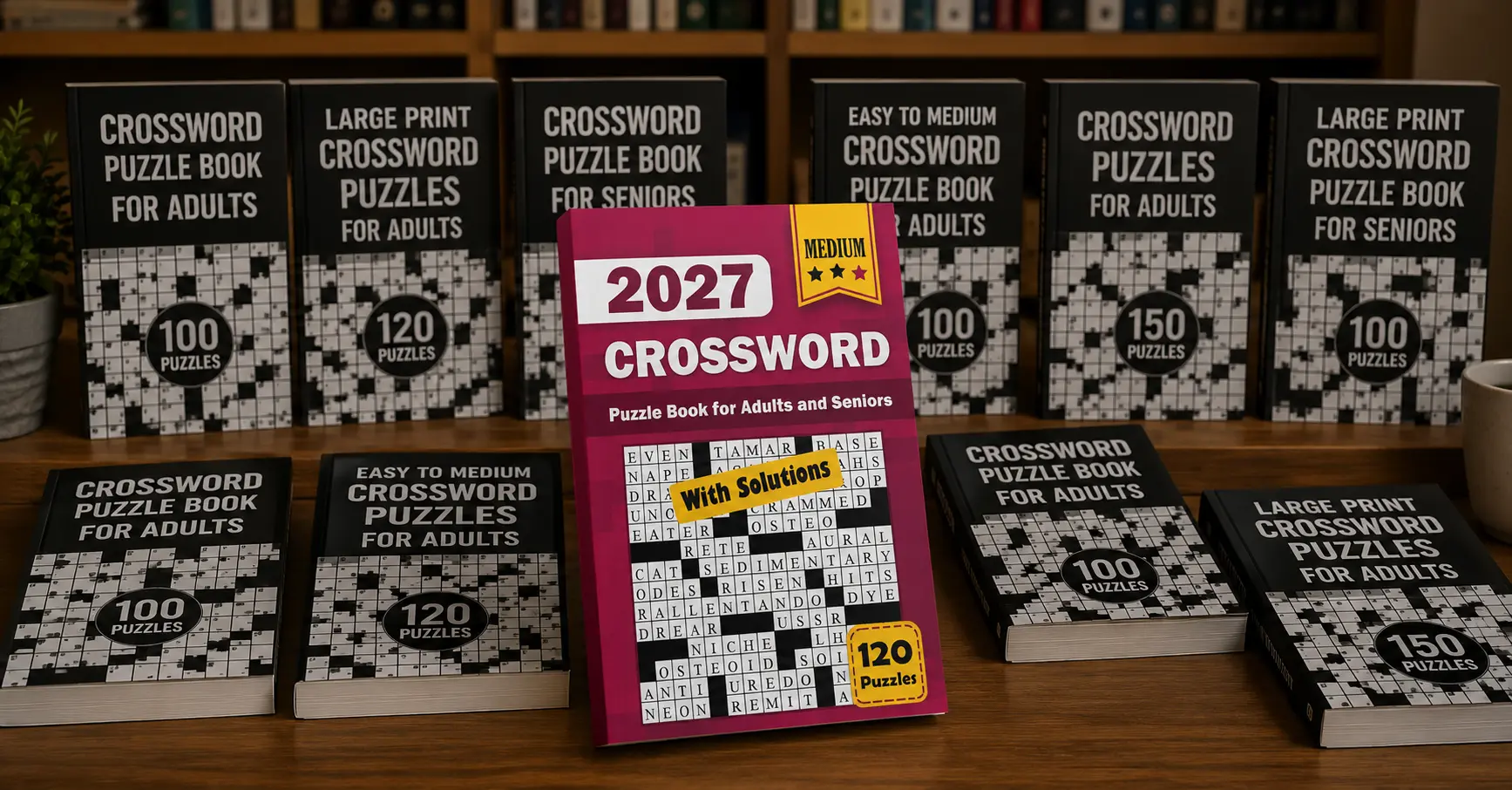
Competition gaps in crowded KDP niches are openings where demand is real but buyers still complain about difficulty, theme, print quality, or large print. Read BSR on the top results with BSR explained for puzzle publishers, then find phrases with Amazon search suggestions for low-content niches.
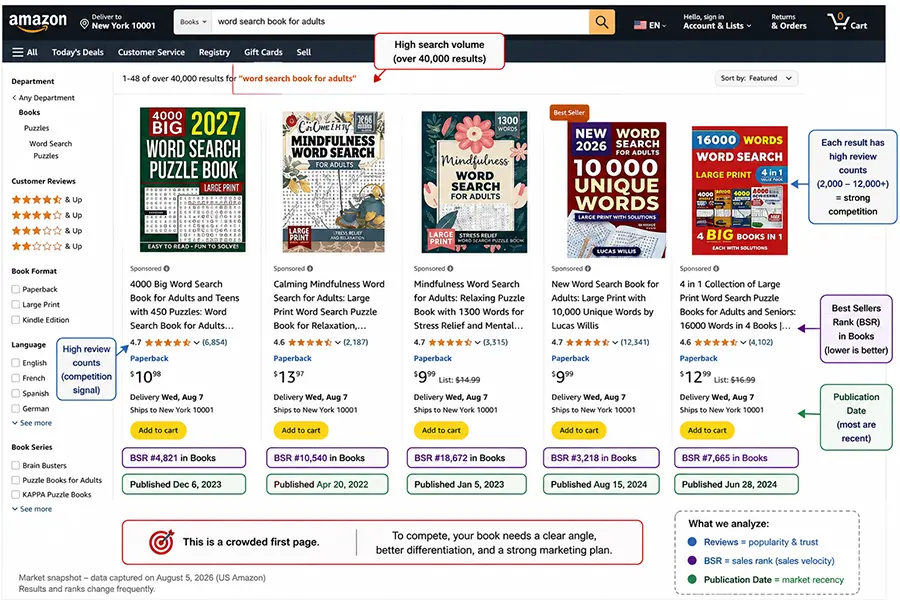
"This niche is too competitive." It is the most common reason new KDP publishers abandon promising opportunities. They search "word search book for adults," see 10,000 results and hundreds of well-reviewed titles, and conclude they cannot compete.
That conclusion is almost always wrong, but only if you understand how to identify a gap inside a crowded niche rather than trying to compete head-on against established titles.
Every high-volume Amazon category is "crowded" at the top. The question is not whether the top 10 results are competitive. They always are. The question is whether there is a specific buyer segment, theme, format, audience, or positioning within that category that is consistently underserved. There almost always is.
This guide teaches you the framework for reading competition in crowded niches, identifying specific types of gaps, building a positioning strategy that sidesteps direct competition, and knowing when a niche is genuinely too crowded to be worth pursuing.
See also: KDP keyword policies, Amazon category strategy, and niche-to-listing workflow.
The Competition Paradox: Why Crowded Niches Are Often the Best Opportunities
There is an important insight that counterintuitive:
A crowded niche proves demand exists. If 50 publishers are selling in a niche, it means 50 publishers are generating enough revenue to stay active. The niche has validated buyer traffic. That is exactly what you want before investing production time.
An empty niche may be empty for a reason. A sub-niche with zero competition could mean: undetected opportunity (rare), too small to be commercially viable (common), or already tried and abandoned (more common than you'd think). Some empty niches look appealing but have never produced a successful title because the buyer simply does not exist at commercial scale.
The goal is not to avoid competition; it is to outmaneuver it. You win in crowded niches not by going head-to-head against established titles, but by finding the corner of the niche that the dominant titles are not fully serving.
The Seven Types of Competition Gaps
These are the specific gap types that consistently yield publishing opportunities inside crowded categories.
Gap Type 1: The Audience Gap
The dominant titles serve a broad audience ("for adults"). A specific sub-audience is buying but not being marketed to directly.
How to spot it: Search "[puzzle type] for adults." Now search "[puzzle type] for [specific demographic]." Count results and compare average BSR and review counts. If the specific demographic search shows fewer results with higher BSRs (lower sales) than the broad search, the audience segment is underserved.
Examples in puzzle books:
"Sudoku for women" vs. the generic adult sudoku niche
"Crossword for men over 50" vs. general adult crossword
"Word search for caregivers" vs. generic adult word search
Entry strategy: Create a title that addresses the specific sub-audience directly in the title, with cover design and word list themes that resonate with that demographic.
Gap Type 2: The Difficulty Gap
The first page is saturated with "easy" and "hard" versions, but intermediate or progressive difficulty is missing.
How to spot it: Check the difficulty distribution on the first page. Are there 6 "easy" and 4 "hard" books but no "medium" or "progressive from easy to hard" editions?
Examples:
Extreme difficulty ("diabolical" or "expert" level) sudoku in a niche dominated by easy/hard
Progressive difficulty crosswords (starts easy, ends expert, one volume)
"Confidence-building" word search, starts very easy and gradually increases
Entry strategy: Fill the missing difficulty position explicitly in your title. "Medium Crossword Puzzles for Adults" may be the exact phrase nobody has written a quality title for.
Gap Type 3: The Theme Gap
Generic titles dominate the first page, but no one has published a specific theme that has search volume.
How to spot it: Run Amazon autocomplete on your seed keyword + theme modifiers. Find themes with autocomplete suggestions but no first-page results, or first-page results that are generic titles ranked there by default, not by thematic optimization.
Examples:
"Birdwatching word search" in a niche dominated by generic animal/nature word searches
"History crossword puzzles" in a niche dominated by generic crosswords
"Golf sudoku" (golf-themed, not golf-puzzle) in a sudoku niche with no sports themes
Entry strategy: Build a theme-optimized title. Your cover, word list, and description all reinforce the theme. This hyper-relevant product earns better conversion from theme-specific searches that the generic titles cannot match.
Gap Type 4: The Quality Gap
Titles rank well based on volume and age, not quality. The existing top titles have poor covers, thin descriptions, illegible interior layouts, or user complaints in reviews.
How to spot it: Read the 1-, 2-, and 3-star reviews of the top 3-5 titles in the niche. Look for patterns: "solutions were wrong," "the print was too small," "cover looked like a scan," "grids were cramped." These are product quality gaps you can systematically close.
Examples:
A top-ranked sudoku book with repeated 3-star reviews saying "difficulty was mislabeled", publish a correctly-calibrated difficulty edition
A dominant word search title with complaints about solution page quality, publish a title with clean, readable solutions
A bestselling maze book with reviews saying "no new themes, same old maze style", publish with varied maze styles
Entry strategy: Address the specific quality failures of the dominant title explicitly in your description and ensure your product genuinely solves them. "Every puzzle validated for single-solution correctness" directly answers the "wrong answers" complaint.
Gap Type 5: The Format Gap
All top titles use the same trim size. The alternative format is underserved.
How to spot it: Check the trim sizes of the top 10 results. If all first-page results for "sudoku for adults" are 6x9, publishing an 8.5x11 large-format edition occupies a different visual position in search results and serves a different buyer.
Examples:
8.5x11 mega-volume in a niche dominated by 6x9 standard books
Pocket (5x8) travel edition in a niche dominated by standard 6x9
Spiral-bound (if applicable) in a niche with only perfect-bound options
Entry strategy: Differentiate your trim size explicitly in the title ("Large Format Sudoku Book, 8.5x11") and cover design. The format itself becomes a search term and a shelf differentiator.
Gap Type 6: The Series Gap
The niche has many individual titles but no well-executed series.
How to spot it: Look at the Volume numbers visible on first-page covers. If most books are Volume 1 only, or if series are present but have inconsistent branding and low cross-series review counts, the niche lacks a dominant series brand.
Examples:
Easy crossword series with consistent branding, covers, and Vol. 1-10 available in one branded series
Progressive sudoku series (Vol. 1 = Easy, Vol. 2 = Medium, Vol. 3 = Hard, etc.)
Themed word search series with 12 volumes covering a different theme per volume
Entry strategy: Commit to 6-10 volumes from day one. Publish Vol. 1 and Vol. 2 within 60 days. The series infrastructure (consistent title format, cover design, cross-sell A+ Content) builds visibility that individual titles cannot match.
Gap Type 7: The Recency Gap
The niche has established titles, but none were published in the last 12-18 months and the existing titles show no publisher activity.
How to spot it: Check publication dates of the first-page results. If the newest title is 2+ years old and the publisher has no other recent titles, the niche is being held by legacy momentum, not active investment.
Examples:
Any evergreen puzzle category where the dominant 3 titles were all published 3-5 years ago
A themed niche where the existing titles used old cover styles that look dated compared to current design trends
Entry strategy: Enter with a fresh design, a modern cover aesthetic, and a well-optimized listing. New publishers can often displace legacy titles within 60-90 days in these recency gaps.
The Competition Analysis Process
Apply this 5-step process to any crowded niche before making a publish/no-publish decision:
Step 1: Map the first page.
Record BSR, review count, publication date, price, trim size, and difficulty label for all first-page results. Build a simple spreadsheet.
Step 2: Read the negative reviews.
Find the 1-, 2-, and 3-star reviews for the top 5 titles. Extract the recurring complaints. These are your quality gap opportunities.
Step 3: Run autocomplete variations.
Check Amazon autocomplete for 10-15 variations of the main keyword (audience modifiers, difficulty modifiers, theme modifiers). Note which variations show lower competition.
Step 4: Identify your gap type.
Using the seven gap types above, determine which gap (if any) is present in this niche. Most crowded niches have at least 2-3 identifiable gaps.
Step 5: Build your positioning statement.
Write one sentence that describes your competitive position: "A [difficulty + format] [puzzle type] for [specific audience], differentiated by [specific gap you are filling]."
Example: "A medium-difficulty large-format crossword book for women over 60, differentiated by fashion and lifestyle themes that the generic adult crossword books never use."
When to Walk Away: Genuine Saturation Signals
Most "crowded" niches have gaps. But some niches are genuinely over-saturated. Walk away when you see:
All seven gap types are filled. The niche has audience-specific titles, multiple difficulty levels, strong themes, quality production, multiple trim sizes, established series, and recent publications. There is no white space.
The top 10 results all have BSR under 20,000. This level of competition requires significant advertising investment and an exceptional product to enter. Not impossible, but the ROI for a new publisher is better elsewhere.
The negative reviews are about the puzzle type itself, not the production quality. If buyers are consistently saying "I don't enjoy this type of puzzle", the niche has a demand problem, not a quality gap.
The first-page BSR suggests a volume ceiling too low for your goals. If the best achievable BSR (#1 in niche) corresponds to 30-40 sales/month, your royalty ceiling is too low to justify the production investment.
Using RodBooks Competition Analyzer
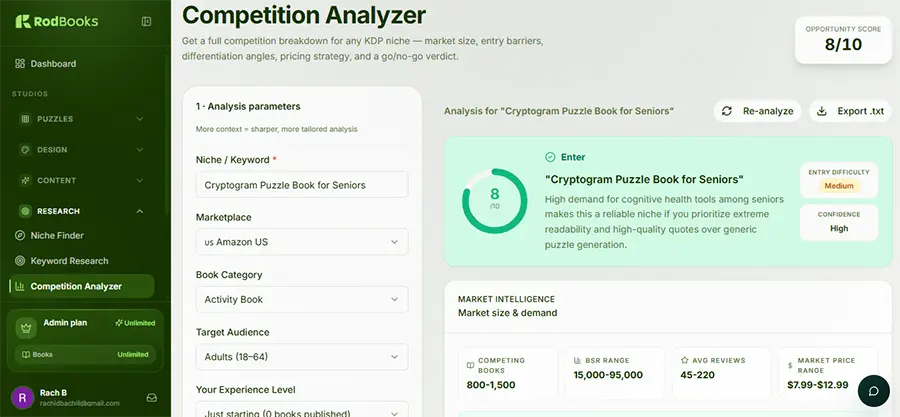
RodBooks Competition Analyzer automates the competitive analysis process, pulling first-page data, identifying review patterns, and surfacing gap opportunities for any puzzle keyword you research.
Frequently Asked Questions
How do I know if a niche is genuinely too competitive or just looks that way?
Check the average BSR of all first-page results, not just the top one. If the average across 10 results is under 50,000, the niche has strong demand breadth and is worth deeper analysis for gaps. If the average is over 200,000, most titles are barely selling and the niche may be genuinely thin.
Should I enter a niche with a dominant title that has 5,000+ reviews?
The review count of the #1 title is not your competition, you are not trying to displace it. You are looking for the gap it doesn't fill. A dominant title with 5,000 reviews in "easy crossword for adults" leaves room for a high-quality "medium crossword for adults" or a themed edition that the dominant title ignores.
How many titles does a niche need to be too crowded?
There is no absolute number. A niche with 200 titles where 190 are poor quality is less competitive than a niche with 30 titles where all 30 are professionally produced. Quality distribution matters more than quantity.
Can I enter a niche with a product that is only marginally better than what exists?
Marginal improvements rarely win. "Slightly better" does not give buyers a reason to choose you over a title with 200 reviews. You need a clear, communicable differentiator (a gap), not just an incremental quality improvement.
Competition Analysis Checklist
First-page results mapped: BSR, reviews, dates, trim, difficulty
Top 5 title reviews read (especially 1-3 stars) and complaints recorded
Autocomplete research run for 10+ keyword variations
At least one gap type identified
One-sentence positioning statement written
Saturation check completed (verified niche is not in the "walk away" category)
Title, cover, and description strategy drafted around the identified gap