What Is BSR? Amazon Best Sellers Rank for Puzzle Publishers
What is BSR on Amazon? Best Sellers Rank for KDP puzzle publishers: how to read it, use it in research, and avoid common pitfalls.
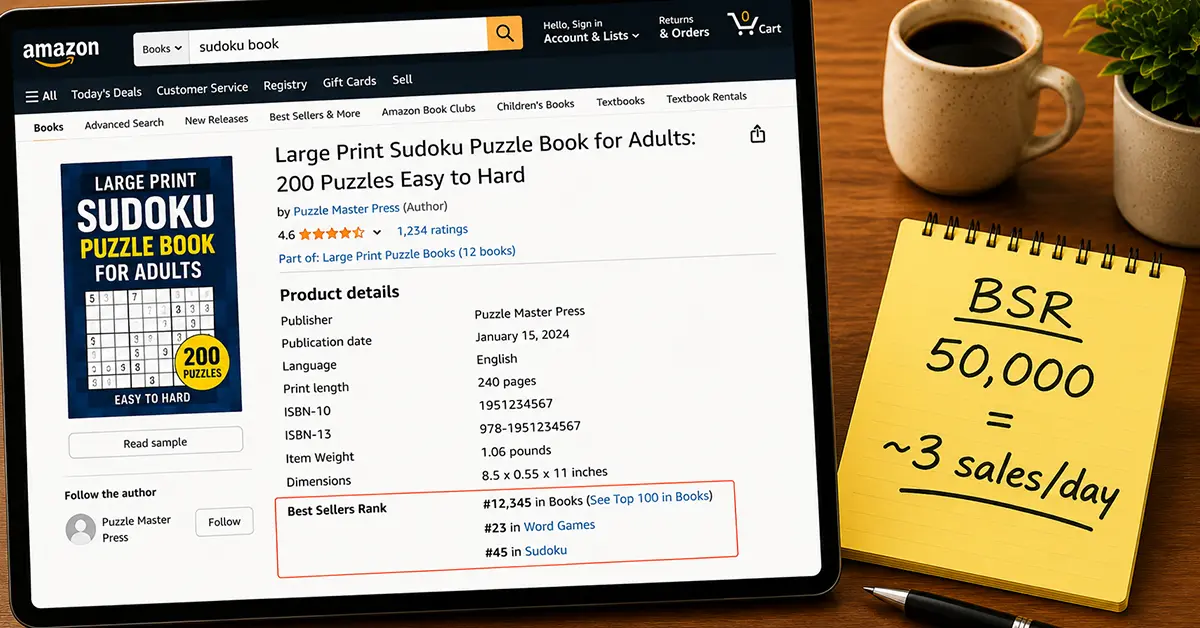
What is BSR? Amazon Best Sellers Rank is a relative sales signal: lower rank usually means more recent sales versus other books in the same store. Puzzle publishers use it to estimate demand before they enter a niche. Pair BSR checks with competition gaps in crowded KDP niches and Amazon category strategy for low-content books.
Best Sellers Rank (BSR) is the most important single number on any Amazon product page for a KDP publisher doing competitive research. It tells you, in near-real time, how well a book is selling relative to every other book on Amazon. If you understand BSR, you can estimate sales velocity, validate niche demand, identify opportunity gaps, and set realistic performance benchmarks, all without paying for any tool.
Most new publishers either ignore BSR entirely or misread it. This guide explains exactly what BSR measures, how to convert it to daily sales estimates, how it changes over time, and how to use it systematically in your niche research and competitive analysis.
See also: Amazon search suggestions research, margin check after niche validation, and full publishing workflow.
What BSR Actually Measures
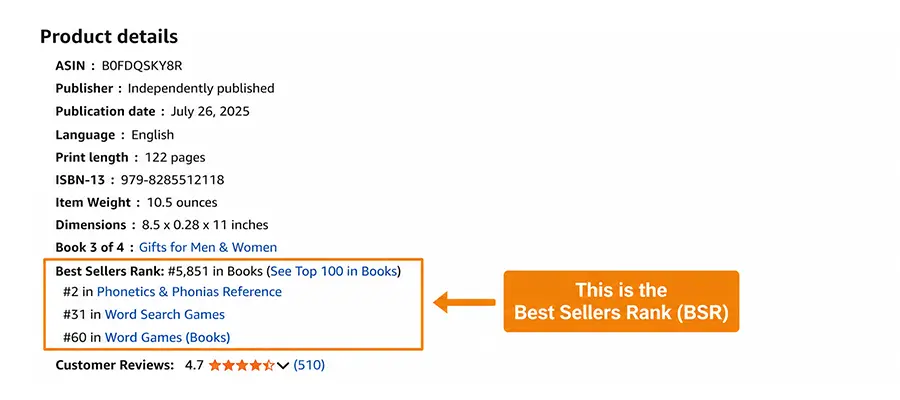
BSR is a ranking number that Amazon calculates for every product in its catalog. A BSR of 1 means the best-selling item in its category. A BSR of 1,000,000 means it is the one-millionth-best-selling item.
Key facts about how BSR works:
It updates frequently. BSR recalculates approximately every hour. A single sale can move a book from BSR 500,000 to BSR 150,000 in under 24 hours. A day without sales can push a book from BSR 50,000 to BSR 200,000.
It is relative, not absolute. A BSR of 50,000 in Books means different things in different time periods, because the total number of books in the Amazon catalog grows constantly, and seasonal demand shifts change all rankings simultaneously. A BSR that represents "3 sales per day" in January may represent "2 sales per day" in August.
It is a composite of recent sales and sales history. Amazon's algorithm weights recent sales heavily but does not ignore historical velocity entirely. A book that sold 1,000 copies last week and zero this week will still hold a better rank than a book with zero historical sales.
Sub-category BSR is separate from main category BSR. A book can have a high (poor) main category BSR but a low (excellent) sub-category BSR. This happens when a book sells well in a niche category but poorly relative to all books combined. Sub-category BSR is often more useful for puzzle book publishers evaluating specific niches.
BSR-to-Sales Conversion Table
The most common question about BSR: "How many copies per day does this rank mean?" There is no official Amazon source for this, but extensive publisher data has produced reliable estimates.
BSR to Daily Sales Estimates (Books category, Amazon.com):
BSR Range | Estimated Sales per Day | Monthly Sales Estimate |
|---|---|---|
1 - 100 | 500-2,000+ | 15,000-60,000+ |
101 - 1,000 | 100-500 | 3,000-15,000 |
1,001 - 5,000 | 20-100 | 600-3,000 |
5,001 - 20,000 | 5-20 | 150-600 |
20,001 - 50,000 | 2-5 | 60-150 |
50,001 - 100,000 | 1-2 | 30-60 |
Important caveats:
These are estimates, not guarantees. KDP paperback royalties help cross-verify: if a book at BSR 50,000 earns ~$100/month in royalties at $3/royalty, that implies 33 sales/month, consistent with the 30-60 estimate above.
Seasonal spikes distort estimates. A Christmas puzzle book at BSR 15,000 in December may represent 30+ sales/day; the same BSR in March may represent 10 sales/day.
These estimates reflect the primary Books category BSR. Sub-category BSR (e.g., "Word Games" or "Sudoku") corresponds to very different absolute sales numbers.
Sub-Category BSR: The Number You Should Be Reading
The main Books BSR is useful for absolute comparisons. For niche research, sub-category BSR is more actionable.
Every book on Amazon has a main category rank (Books) and up to 3 sub-category ranks. A puzzle book might show:
#34,567 in Books
#45 in Word Games
#12 in Crossword Puzzles
The sub-category BSR tells you how the book ranks within your specific competition pool. A rank of #12 in Crossword Puzzles is meaningful, it tells you this book is the 12th best-selling crossword puzzle book on Amazon.
For niche validation: Check what BSR the #1 book in your target sub-category holds in the main Books category. If the #1 crossword book has a main BSR of 15,000, that tells you the entire crossword category has strong demand, the top title sells at a velocity that produces BSR 15,000+ in all of Books. If the #1 book in your target sub-category has a main BSR of 300,000, the niche has limited demand.
How BSR Changes Over Time: Interpreting Trends
A single BSR snapshot gives you a moment in time. A pattern over time tells you far more.
A rising BSR (number getting bigger) = slowing sales. If a book was at BSR 20,000 last month and is now at BSR 80,000, sales have dropped significantly.
A falling BSR (number getting smaller) = accelerating sales. A book moving from 200,000 to 30,000 has started selling aggressively, perhaps from a price drop, ad campaign, or external marketing push.
A stable BSR = consistent sales velocity. A book that has been at BSR 40,000-60,000 for three consecutive checks is a steady performer, probably 2-3 sales per day consistently.
How to track BSR over time:
You cannot see historical BSR on Amazon's product page. Options for tracking:
Check and manually record BSR weekly in a spreadsheet
Use a BSR tracking tool (some available for free with limited checks)
Check the Movers and Shakers list in Books to see which titles are gaining rank rapidly
Using BSR in Competitive Research: The Three-Step Process
When you find a potential niche through keyword research, use BSR to validate it with this process:
Step 1: Find the demand ceiling
Search your target keyword on Amazon Books. Record the BSR of the #1 organic result. This is your demand ceiling, it tells you the maximum sales velocity achievable in this niche right now with the best-positioned title. A BSR under 50,000 means the ceiling is commercially meaningful.
Step 2: Map the first page
Record the BSR of every result on the first page (usually 16-20 results). Calculate the average. If the average BSR is under 150,000 across the first page, the niche has breadth, multiple titles are selling, not just the top one. If only the #1 title has a low BSR and the rest are above 500,000, the niche is winner-take-most and harder to enter.
Step 3: Find the floor
Identify the lowest-ranked (highest BSR number) title on the first page. If that title, despite appearing on the first page, has a BSR of 800,000, it is getting virtually no sales. This means the first page is being held by historical momentum, not current demand, and new entries can displace these titles relatively easily.
Setting Your Own BSR Benchmarks
As a publisher, use BSR to set three internal benchmarks:
Break-even BSR: Calculate what BSR you need to cover your time and investment. At $3/royalty and 1 sale/day (BSR ~150,000), you earn ~$90/month per title. At 5 sales/day (BSR ~30,000), you earn ~$450/month. Set your minimum acceptable BSR based on your target per-title revenue.
Target BSR at 90 days: A newly published KDP book typically takes 30-90 days to reach its organic ranking equilibrium. Set a 90-day BSR target and use your first month's ad data to project whether you are on track.
Portfolio average BSR: Across your entire catalog, what is your average title's BSR? A portfolio of 20 titles with an average BSR of 80,000 is generating much more revenue than a portfolio of 5 titles with an average BSR of 30,000. Total portfolio performance matters as much as individual title performance.
Common BSR Misreadings to Avoid
Misreading 1: Judging a niche by one BSR check
A book at BSR 20,000 today may have been at BSR 200,000 last week after a promotional price drop. Always check multiple data points before concluding a niche is strong.
Misreading 2: Comparing sub-category BSR to main BSR
A #5 rank in "Crossword Puzzles" might correspond to a main BSR of 80,000. A #5 rank in "Humor" might correspond to a main BSR of 8,000. Sub-categories vary enormously in total sales volume. Always cross-reference sub-category BSR with main category BSR.
Misreading 3: Assuming BSR 1 = maximum possible sales
The BSR 1 book changes hourly. In the Books category, the #1 book might be a viral bestseller doing 10,000 copies/day. The following week, a different book may occupy BSR 1 at 1,000 copies/day. The absolute top is unstable and not a meaningful benchmark for puzzle book publishers.
Misreading 4: Ignoring seasonal context
BSR in December for Christmas puzzle books will be dramatically better (lower numbers) than in March. Never evaluate a seasonal title's BSR out of its season.
How to Use RodBooks Tools Alongside BSR Research
RodBooks Keyword Research and Niche Finder pull Amazon data to help you interpret BSR signals alongside keyword volume and competition scoring, so you are not manually recording BSR across dozens of search pages.
Start your BSR-informed niche research →
Frequently Asked Questions
What BSR is considered "good" for a KDP puzzle book?
Context-dependent, but as a general rule: BSR under 100,000 in Books means the title is earning at least one sale per day. BSR under 50,000 means 2-5+ sales per day. For a puzzle book priced at $9.99 with a $3 royalty, BSR 50,000 generates roughly $270-450/month. For a serious KDP publisher, a target of BSR under 50,000 within 90 days is a reasonable performance benchmark.
Can BSR change without any sales?
Yes. BSR is relative. If competing books sell more copies and outperform your title, your BSR will increase (worsen) even with zero sales. Similarly, in a slow sales period (like January post-holiday), all book BSRs tend to rise because total Amazon book sales volume drops.
Does Kindle Unlimited borrow count toward BSR?
KDP Select/KU borrows do affect BSR for eBooks. For paperbacks, only paid sales count toward BSR.
How many books does BSR 100 in Books mean?
Very roughly, BSR 100 in the Books category corresponds to 200-1,000+ sales per day depending on the current overall marketplace volume. At that level, a puzzle book would be an outlier bestseller. Realistic targets for puzzle book publishers are BSR 10,000-100,000.